
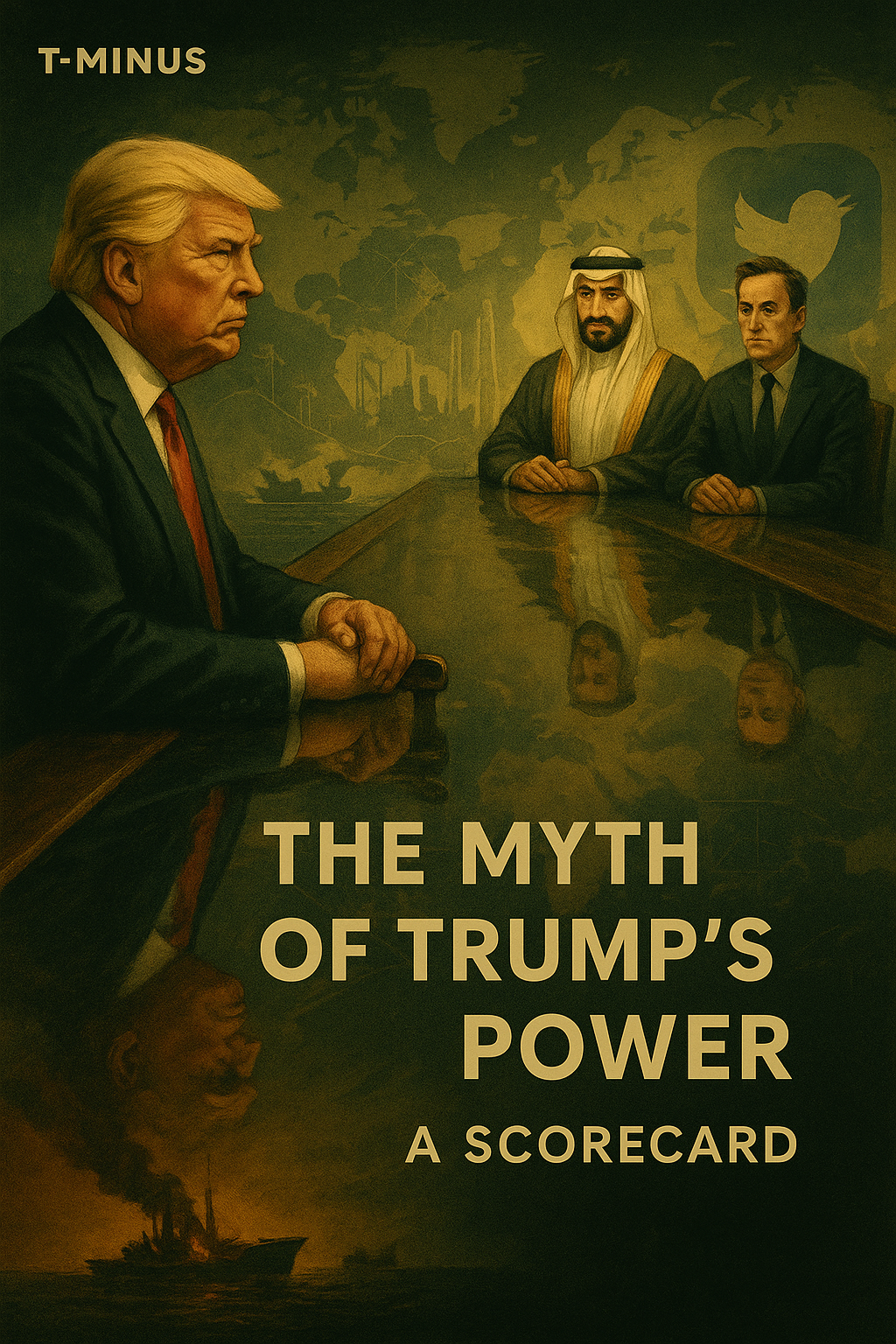
T-MINUS
The Myth of Trump’s Power — A Scorecard
Filed from the edge of a year that feels like a fever breaking — or a dam cracking.
Power in America has always been a kind of performance art, a civic hallucination staged for a restless audience that wants to believe its leaders are titans instead of tired men yelling into microphones. But there are moments — rare, unpleasant moments — when the smoke machine jams and the stage lights flicker, revealing the cheap scaffolding behind the spectacle.
This is one of those moments. T-Minus to next November, and the country can feel the countdown in its teeth.
Donald Trump still strides across his rallies and golf courses with the posture of a man who believes his own mythology: the dealmaker, the negotiator, the kingmaker, the man who bends nations to his will. But if you want to understand the myth of Trump’s power — this lacquered illusion that has held the American psyche hostage for nearly a decade — you have to look not at what he says, but at what he tries to distract you from.
Start with the theater.
The Myth: A Man at the Center of the World (Or So He Thinks)
Picture the dinner table: Mohammed bin Salman floating into the White House with the sort of ease that comes from knowing the most expensive seat is always waiting for you. Elon Musk perched beside him, brittle and restless beneath the weight of his own legend. And Trump — positioned somewhere between host and supplicant — basking in the glow of men who control more money, more data, and more strategic leverage than any American president since the Cold War.
Roughly fifty percent of Saudi Arabia is on Twitter. Say that twice. Internalize what it means. A country doesn’t need a Ministry of Information if it owns the platform where its people think out loud.
MBS understood that. Musk understood that. Trump, dazzled by the proximity to power, misread the geometry. He wasn’t at the apex of the triangle — he was its most easily manipulated vertex.
The spectacle radiated strength: private jets on standby, Gulf sovereign-wealth money circling Trump properties, billionaires bending toward him like sunflowers chasing false light. But like all theater, it concealed something smaller and sadder underneath: a man who interpreted flattery as loyalty, investment as allegiance, and access as control.
And outside the glow of those photo-ops, the rest of the world kept moving without him.
Iran: Where the Fuse Burned and the Strongman Shrinks
Israel’s covert strike on Iran’s nuclear infrastructure last June — with or without Trump’s blessing — rattled the region like a hammer on sheet metal. For a moment, the world held its breath. The fallout didn’t elevate Trump; it embarrassed him. Iran retaliated with icy confidence, shrugged off IAEA resolutions, and moved still closer to Russia. Iranian nuclear scientists visited Moscow. The Kremlin hailed an “all-areas” partnership. Tehran’s strategic position hardened like cooling steel.
Trump was not on the stage; he was in the audience. Watching. Guessing. Posting statements into the void of his own diminished relevance.
Russia: The Man Who Played Him Like a Lodge Piano
Vladimir Putin did not flatter Trump. He didn’t need to. He simply nudged the pieces of the world into more favorable positions: Iran strengthened, NATO strained, U.S. influence diluted. Trump, absorbed by the sound of his own voice, failed to notice that he had become a spectator to a geopolitical realignment, not its architect.
And then there was the violence — not the geopolitical kind, but the theatrical kind.
The Fishing Boats: A Strongman’s Shadowplay
Out in the Caribbean and the Pacific, American forces obliterated fishing boats — not enemy vessels, not legitimate targets, just boats full of men trying to earn a living on open water. It was violence without strategy, fury without context, the rawest form of projection: a president who could not command respect choosing instead to command explosions.
This was not power. It was insecurity made manifest.
On cable news, loyal courtiers like Pete Hegseth yapped happily in the background like patriotic Pomeranians, insisting that the kingdom was secure, the leader was strong, and the empire was unshaken.
But myth only survives if nobody checks the math.
The Scorecard: The Places Where Power Has to Be Real
If you want to measure a man’s power, look at the institutions he cannot bully.
This is the Washington Jenny Braddock knows well: the one that measures strength in outcomes, not in rallies or soundbites.
1. The Felonies
In May 2024, a New York jury found Trump guilty on 34 felony counts. A conviction is not a myth. It is paperwork. It is ink on a docket. It is the heavy grind of the law that no chant can overwrite.
2. Sentencing
In January 2025, the sentencing orders arrived. He is not running above the law. He is running ahead of it, hoping it gets tired before he does.
3. The Ninety-Three Percent Failure Rate
Almost every meaningful administrative action undertaken during his presidency was blocked in court. Roughly ninety-three percent. It is the kind of number that would get a law student expelled, a general relieved of duty, or a CEO quietly escorted out of the building.
4. The Supreme Court Declined His Coronation
In June 2025, the Supreme Court slapped down his claims of sweeping executive power. A partial stay here, a narrowed ruling there, but the message was unmistakable: you are not sovereign. You are supervised.
5. Two Impeachments, Zero Vindications
History will remember the impeachments. The acquittals will read like the fine print at the bottom of a bad contract. Twice, the House laid out the case; twice, the Senate chose evasion over accountability.
6. The Comey Fantasy Collapsed Under Its Own Weight
Years of accusations, insinuations, and half-baked conspiracy theories dissolved when examined in daylight. No treason. No coup. Just bureaucratic inertia and a president who mistook resentment for evidence.
7. Immigration Overreach, Hammered Repeatedly
From DACA to deportations to parole status, federal courts built walls faster than he could tear them down. Even as late as November 2025, appellate judges were still untangling contempt issues around illegal deportations and ignored injunctions.
8. Foreign Aid Manipulation
Courts reinstated grants, blocked punitive cuts, and held the line against small, vindictive attempts to use foreign aid as a personal loyalty test. The message, once translated out of legalese, was simple: the federal budget is not your private slush fund.
9. The National Guard Deployment Was Ruled Illegal
On November 20, 2025, a federal judge finally wrote, in plain English, that Trump’s attempt to deploy the National Guard into Washington, D.C. was not just reckless. It was unlawful.
10. Congress Disappeared for Seven Weeks
Not metaphorically. Literally. A bipartisan vanishing act timed precisely to avoid handling the Epstein files. Seven weeks of procedural fog. Seven weeks of camera-dodging and schedule conflicts. When they resurfaced, nothing had changed except the smell of fear.
11. Total Litigation: 547 Cases and Rising
A presidency that generated lawsuits like sparks off a broken transformer. Lawyers gorged, courts groaned, democracy limped forward one injunction at a time. By late 2025, at least 547 legal challenges had been logged against Trump-era actions.
The Collapse: Where the Truth Leaks Through
Underneath all of it — underneath the jets and the dinners, the threats to Volodymyr Zelensky to “make a deal by Thanksgiving,” the red lines in the Middle East, the bombed fishing boats and the frantic press releases — there is the shadow nobody in Washington wants to look at directly:
the dead pedophile billionaire who, in his own grotesque way, was the real most powerful man in the world.
Not because he governed anything. Not because he built anything. But because he kept his receipts. Because he knew where the bodies — figurative or otherwise — were buried. Because the powerful men who orbited him still tremble at the thought of what might surface.
It is that fear — not Trump’s bluster — that explains the seven-week congressional silence. It is that fear that explains the breathless need for distraction. It is that fear that explains why Trump is now dangling Ukraine’s survival over a holiday deadline, threatening to cut Zelensky loose unless the war ends on terms that make no strategic sense but conveniently move the cameras away from the island no one wants to name.
Trump can command a microphone. He can command loyalists. He can still command chaos.
But real power — power that survives subpoenas, indictments, appeals, and daylight — is something else entirely. And the scorecard tells the story plainly: he never had it.
As we enter the final stretch before next November — T-Minus and counting — the myth that sustained him is collapsing under the weight of its own contradictions. A man who once sold strength by the pound is now trying to outrun a file folder. A geopolitical world he cannot control is reshaping itself without him. A Congress terrified of one dead man’s legacy is pretending not to see the fire creeping across the floor.
The countdown is not just to an election. It is to clarity.
And clarity, finally and mercifully, has no use for myths at all.


