
![[Aggregator] Downloaded image for imported item #269679](https://batshitcrazy.com/wp-content/uploads/2026/02/header-3-1068x801.jpg "[Aggregator] Downloaded image for imported item #269679")
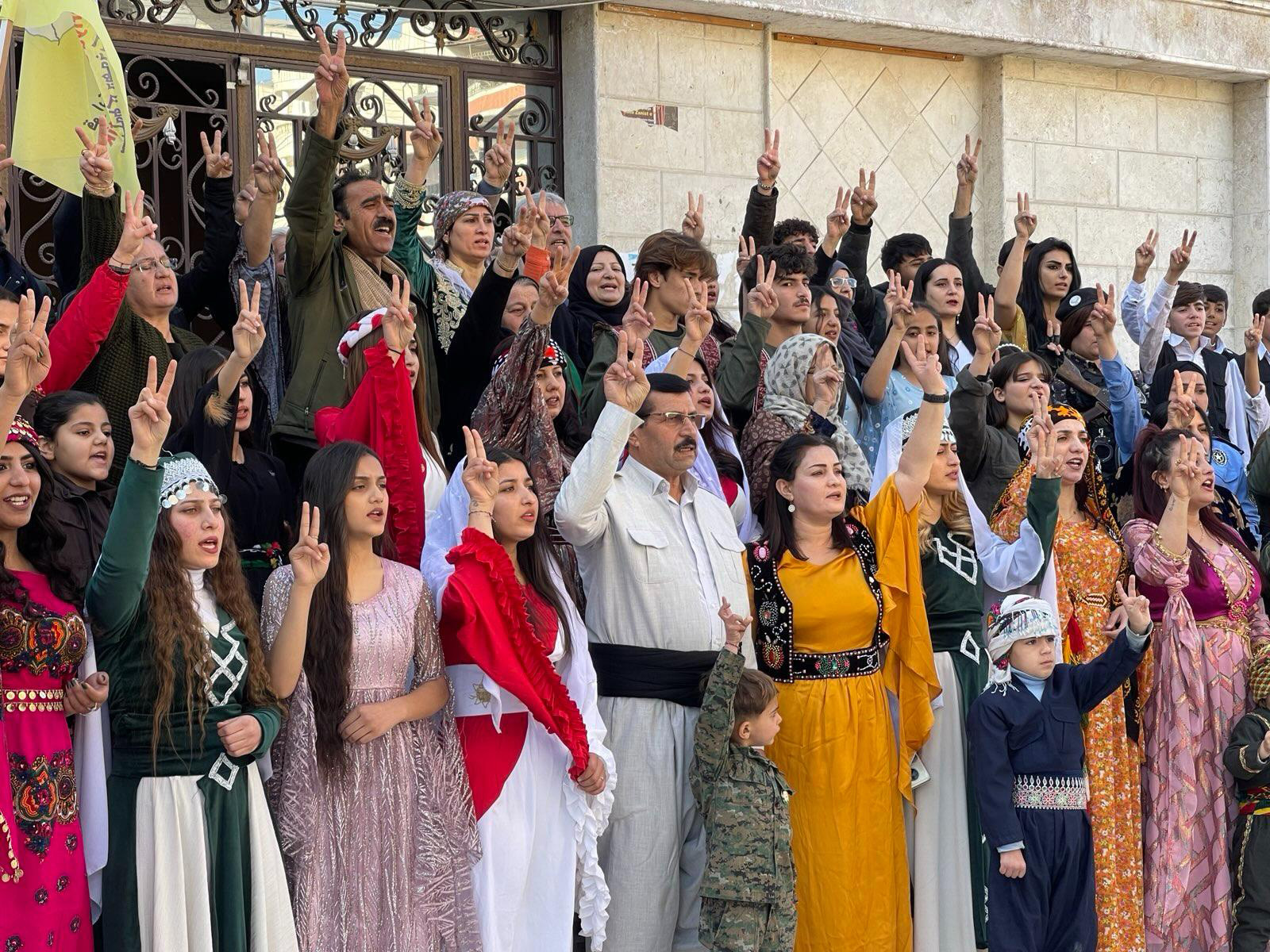
With the backing of the Turkish government and the blessing of the United States and European governments, the Syrian military is surrounding the self-governing communities of Rojava, seeking to forcibly integrate them into the Syrian state. Although the Syrian Democratic Forces (SDF) in Rojava have signed a peace treaty agreeing to integration, the outcome remains to be seen.
At the conclusion of 2024, Turkish-backed insurgent forces entered Damascus, overthrowing the regime of Bashar al-Assad. Their leader, Ahmed al-Sharaa, known by the nom de guerre Abu Mohammad al-Julani, became president of Syria. Over the following year, the new Syrian government set out to curry favor with imperial powers around the world, including the regime of Donald Trump, in order to consolidate power over the country.
On January 6, 2026, the Syrian transitional government launched an offensive in coordination with jihadist paramilitary forces against the Kurdish neighborhood Sheikh Maqsood in the city of Aleppo. The SDF withdrew on January 10 along with a large number of displaced refugees.
Three days later, the Syrian government attacked Rojava as a whole. On January 18, Syrian president Ahmed al-Sharaa announced a ceasefire agreement with the SDF, but fighting resumed immediately. Rojava faced the threat of a full-scale war of extermination, including the possibility that the Turkish military would invade once again. On January 20, the SDF agreed to a ceasefire stipulating that the region will be subordinated to the Syrian government in Damascus and the SDF will be integrated into the Syrian military. Yesterday, this ceasefire was extended; but as of now, parts of Rojava remain under siege.
Although proponents of the state claim that a strong and centralized government is necessary to prevent “chaos” and ethnic violence, we can see that in Syria, the opposite is true: those who aim to centralize state power in their hands are using ethnic violence as a means to do so. This is hardly the first time in history that an effort to unify a country under a centralized government has coincided with a campaign of ethnic cleansing.
Here, we present a statement from American, Chinese, and Russian anarchists who have fought to defend Rojava about what these latest developments mean for the future. For more background on the history of this conflict, you could begin here. You can follow updates from anarchists in Rojava here.
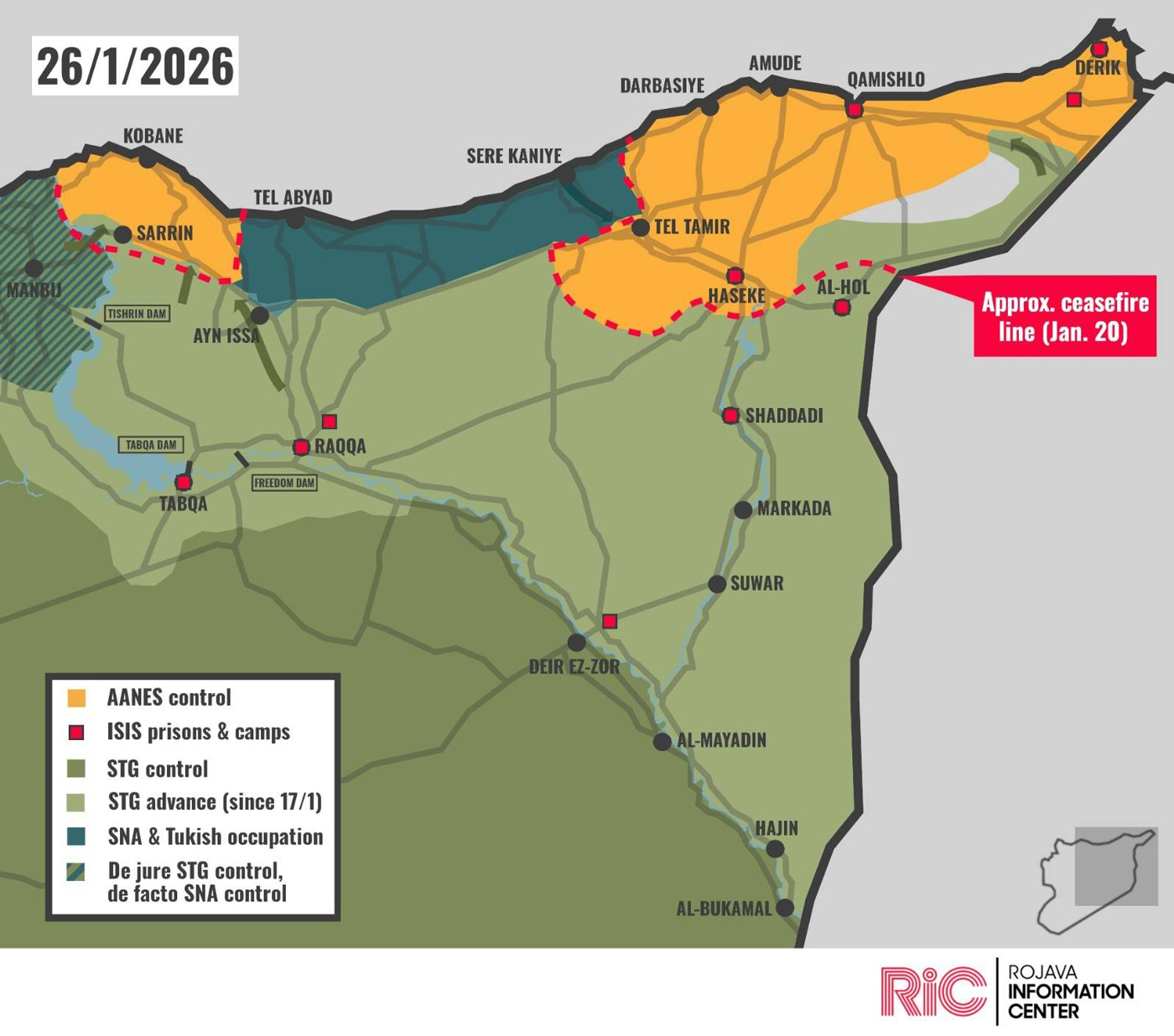
A map of the region on January 26, 2026, after the pause in hostilities.
In 2012, as the regime of Bashar al-Assad began to lose control of the country at the outset of the Syrian revolution, Kurdish groups that had been organizing underground for decades seized the opportunity to fill the power vacuum, expanding their autonomous structures to defend their people. Over the years that followed, the Rojava revolution became a multi-ethnic force consisting of Arab, Kurdish, Syriac, Assyrian, Armenian, Yezedi, and Turkmen communities, among others. In battle after battle, the combined strength of these communities within the Syrian Democratic Forces (SDF) liberated a large swathe of land from the Islamic State of Iraq and Syria (ISIS) and other fundamentalist factions, bringing relative security, stability, and autonomy under the principles of democratic confederalism proposed by the Kurdish freedom movement and its imprisoned leader Abdullah Öcalan.
The autonomous administration of Rojava demonstrated that there is an alternative to the rule of autocratic dynasties and brutal theocracies in the Middle East. Yet the revolution has many enemies—most prominently, the settler-colonial Turkish state under the leadership of the neo-Ottomanist Recep Tayyip Erdoğan. To undermine Kurdish self-determination, the Turkish state has long sponsored fundamentalist groups in Syria, sheltering the al-Qaeda affiliate Hayat Tahrir al-Sham (HTS), cultivating a puppet force in the Syrian National Army (SNA), and facilitating the flow of money, personnel, and weapons to the Islamic State (ISIS).
However, Turkey is not the only geopolitical force that has sought to establish hegemony in northeastern Syria. France colonized Syria in the early 20th century; the United Kingdom played a pivotal role in dividing the people of Kurdistan into four nations. Later, starting in the 1990s, the government of the United States of America waged a generation of wars in neighboring Iraq, dramatically destabilizing the entire region and contributing to the rise of Sunni fundamentalist groups like Al-Qaeda. The Russian state supported the Assad regime militarily, economically, and politically; Vladimir Putin was the main guarantor of its existence in the face of the popular uprising that became the Syrian revolution. Together with his counterparts in Washington, DC, Putin is now building military and economic ties with the new Syrian regime, helping it to solidify its grasp on power. Donald Trump’s family has extensive business ties to Qatar, and his administration’s strategic interests broadly overlap with those of the global Sunni geopolitical axis involving the Turkish government and the Gulf States, especially when it comes to Iran.
In many ways, fundamentalist movements such as al-Qaeda and ISIS are a consequence of the instability that various foreign powers have inflicted on the entire region. Despite their rhetoric about a “war on terror,” these empires have introduced war, terror, and tremendous suffering to this land.
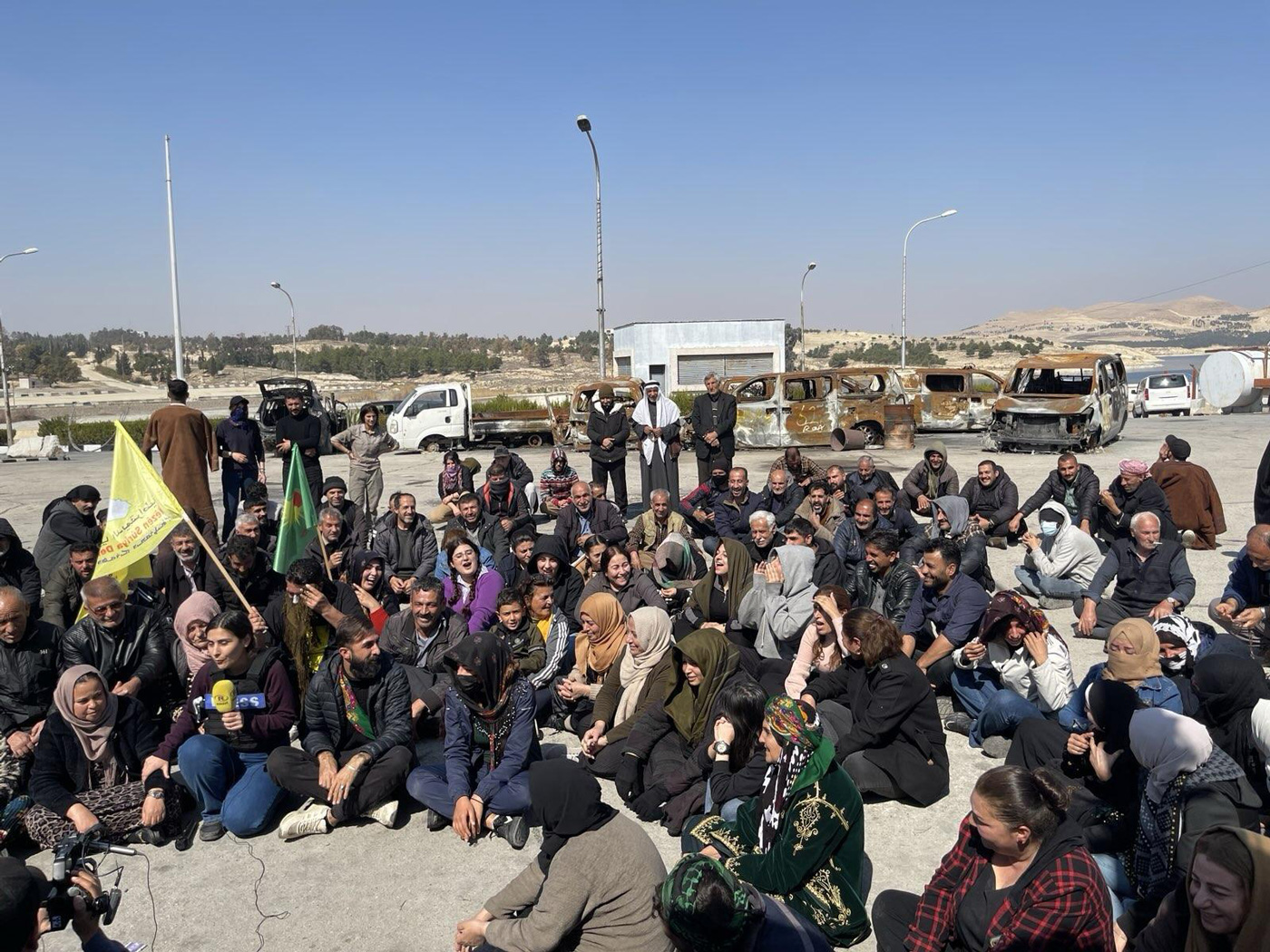
Caught within the struggle for dominance over the region by competing American, Russian, Turkish, Israeli, and Iranian powers, the revolutionary autonomous project of Rojava never had a future in the plans of any empire or nation-state.
In 2018 and 2019, the Turkish army and its Syrian proxy SNA occupied the territories of Afrin and Serekaniye, immediately purging the indigenous Kurdish population from these areas. Following the rapid collapse of the Assad regime in 2024, the HTS-led Syrian Transitional Government (STG) now seeks to impose the banner of Sunni-Arab nationalism and sectarianism upon all the territories of Syria. The new Syrian army has advanced with brutality, aiming to destroy the most important achievements of the Rojava revolution—women’s liberation and the comparatively peaceful co-existence and self-governance of all ethnic groups. There are hundreds of videos and pictures recording the crimes committed by transitional government soldiers as they advanced in 2025 and 2026. In January 2026, many recorded themselves mutilating the bodies of women fighters and cutting off their braids as trophies.
Most of the lands that the revolution liberated from ISIS are now back in the hands of theocratic fascists: Manbij, Tabqa, Raqqa, Deir ez-Zor, Shaddadi. As internationalists, we took part in the liberation of much of this terrain, fighting shoulder to shoulder with our Arab and Kurdish friends. Many of our comrades sacrificed their lives for the revolution in these places. It is painful to watch these achievements undone.
Western governments have given Damascus the green light to subject Rojava to the threat of a war of extermination. They are just as responsible for the situation as Turkey and the STG. Yes, the Western military coalition played a role in the struggle against ISIS; their support was instrumental in the defense of Kobani in 2014 and the liberation of Raqqa in 2017. That only makes their betrayal of the SDF more instructive: they are prepared to use Kurdish people as cannon fodder, but they would rather see ethnic cleansing in Rojava than a multi-ethnic, egalitarian experiment that exceeds the control of nation-states.
The heads of these governments hurried to shake the hand of Abu Mohammad al-Julani after the arrival of HTS in Damascus swept him into power. At the same time that these governments declare that they look forward to working with the new Syrian government to combat ISIS, ISIS loyalists and sympathizers are in the ranks of the STG, displaying their flags.
Al-Julani’s vows to protect minority groups have been revealed to be falsehoods. First, al-Julani’s forces went west to massacre the Alawites. Then, they drove south to decimate the Druze. Then, with the blessing of the governments of Turkey, the United States, France, and Israel, they pushed east to attack the Kurds and the diverse array of other communities that dare to defend the shared project of a multi-ethnic, multi-religious society.
To prevent the Syrian government from fabricating the narrative that Kurdish people were occupying Arab lands and making war on Arab people, the SDF withdrew to Kurdish-majority areas, where they managed to halt the advance of the government forces. Through fierce resistance, they managed to block the original plan to physically annihilate Rojava, forcing Damascus back to the negotiating table. But the current ceasefire is fragile, the steps to integrate Rojava into the Syrian state are vague, and it remains to be seen to what extent the Syrian government will honor any of its promises.
The Syrian military still has not lifted the siege of Kobane. Hundreds of thousands of displaced people still cannot return to their homes.
As internationalists, we condemn the American, Russian, and European governments. This treachery is just the latest in a long list of their crimes against humanity. It is clear to us that all nation-states operate without ethics or morality. The machinery of the state has no humanity and the people who run this system have lost theirs, as well. Oil and resource extraction, trade routes, spheres of influence, and political and military hegemony are the language and principles of empire. According to imperial logic, this latest betrayal of the Kurdish people by the American government constitutes a mere policy change, regardless of how much bloodshed it brings about.
As enemy forces besiege Kobanê and set their sights on Heseke, Til Temir, and Qamişlo once again, we remain committed to defending the revolution. Only time will tell if the current ceasefire will hold. Every time that the SDF has rejected the unacceptable terms that Damascus seeks to impose, STG forces seize the opportunity to unleash a terror campaign against the population while blaming the SDF. Yet more symbolic representation for Kurds and other communities in Syrian government and society will solve nothing. As long as fundamentalist Islam, sectarian violence, and the politics of centralization drive Al-Julani’s regime, there will be no lasting peace in Syria.
This crisis has put a spotlight on the chief goals of the movement in Rojava: to defend the people who live here, to resolve conflict through political rather than military means, to enable people to organize themselves as they see fit. All of these values remain intact, even though the SDF and the autonomous administration of Rojava have been compelled to agree to a peace treaty on unfavorable terms.
In response to the agreement, some people outside Rojava are portraying the revolution as defeated—while at the same time, some of us remain in defensive positions around Rojava with rifles in our hands, still prepared to prevent the enemy from advancing. Revolutions are not defeated by decisions imposed from above; they are determined by what ordinary people decide to do, even in the most adverse conditions. Whatever happens, we will continue fighting for, side by side with, and from within this revolution. This is a setback, but it is not the end of the story.
As long as we are able to organize with the people around us, to offer space for internationalist comrades, to pursue collective education and training, to advance the cause of a self-governed society coexisting in diversity and exercising women’s freedom, we will continue to do all of these things. The agreement with Damascus may compel us to engage in these activities differently, but it will not stop us. It will not be easy to put an end to what has begun here.
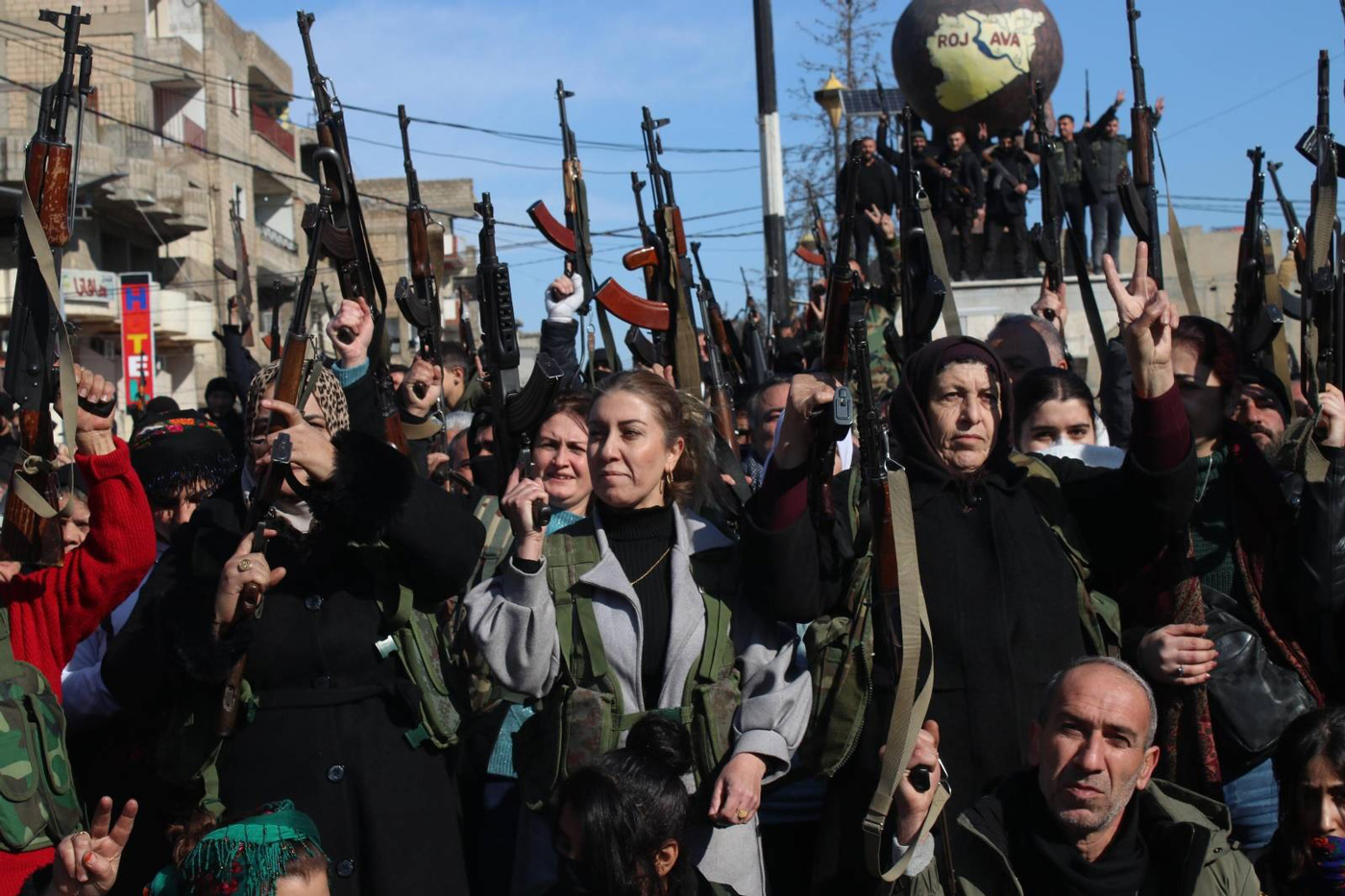
We call on all anarchists, socialists, anti-fascists, and internationalists to remain committed to the defense of the Rojava revolution and the communities that are a part of it, whatever takes place in the negotiations between SDF officials and the Syrian government.
The preservation of people’s power and autonomy in distant lands starts on your own homefront, especially in countries that are powerful actors in international politics. We have learned humbly from the revolution in Rojava—from its forms of organization, from its revolutionary spirit, from the readiness of the participants to sacrifice and from their courage in the face of powerful enemies. We understand that our weapons and bodies alone are no match for the war machines of empire and modern nation-states. To counter such an enemy will require a global revolutionary people’s war.
Without fundamental changes to the international order, Rojava and all social revolutions and liberation movements will always be at the mercy of great powers. They will take advantage of our experiments when it is convenient, then abandon and crush us when we are no longer of use to them. The only way to neutralize this threat is to engage in internationalist cooperation and organization, uniting our struggles globally. Today, the defense of Rojava is one front and focal point of such efforts.
To offer practical support on an immediate basis, you can donate to projects like Heyva Sor, Riseup4Rojava, and Tekoşîna Anarşîst and raise awareness about the plight of Rojava via social media, press releases, distributing zines and books, and showing movies.
As a longer-term organizing strategy, we can connect the Kurdish struggle with other fronts engaged in parallel struggles. In the United States, the racist violence that ICE is perpetrating to advance Trump’s kleptocracy mirrors the strategy of al-Julani, who has awarded government and military positions to the jihadists who are committing massacres in order to forcibly integrate minority communities into a “unified Syria.” In addition to spreading information and narratives, we must also connect people’s concrete needs with political ideas about how we can meet them together, building networks and mutual support groups that can connect people of a variety of backgrounds. Finally, while electoral politics will never function as a vehicle for fundamental change, in some places, it may possible to pressure politicians not to be complicit in enabling ethnic cleansing to occur in Rojava or elsewhere.
We write as anarchist internationalists hailing from the three most powerful empires of our time: the United States, Russia, and China. On a planet catapulting toward ecological catastrophe and a third world war, we seek to transcend geopolitical fault lines and repressive political dichotomies in order to stand side by side in struggle against our oppressors. If we are to bring about a new global system based on autonomy, justice, and social plurality, the current system of nation-states, economic exploitation, and patriarchy must be dismantled. We are told of wars between empires, but everywhere we look, we only see wars of all shapes and forms against the people. The undoing of empires must therefore come from within, from the people, through our own self-organized initiative.
With revolutionary greetings and respect.
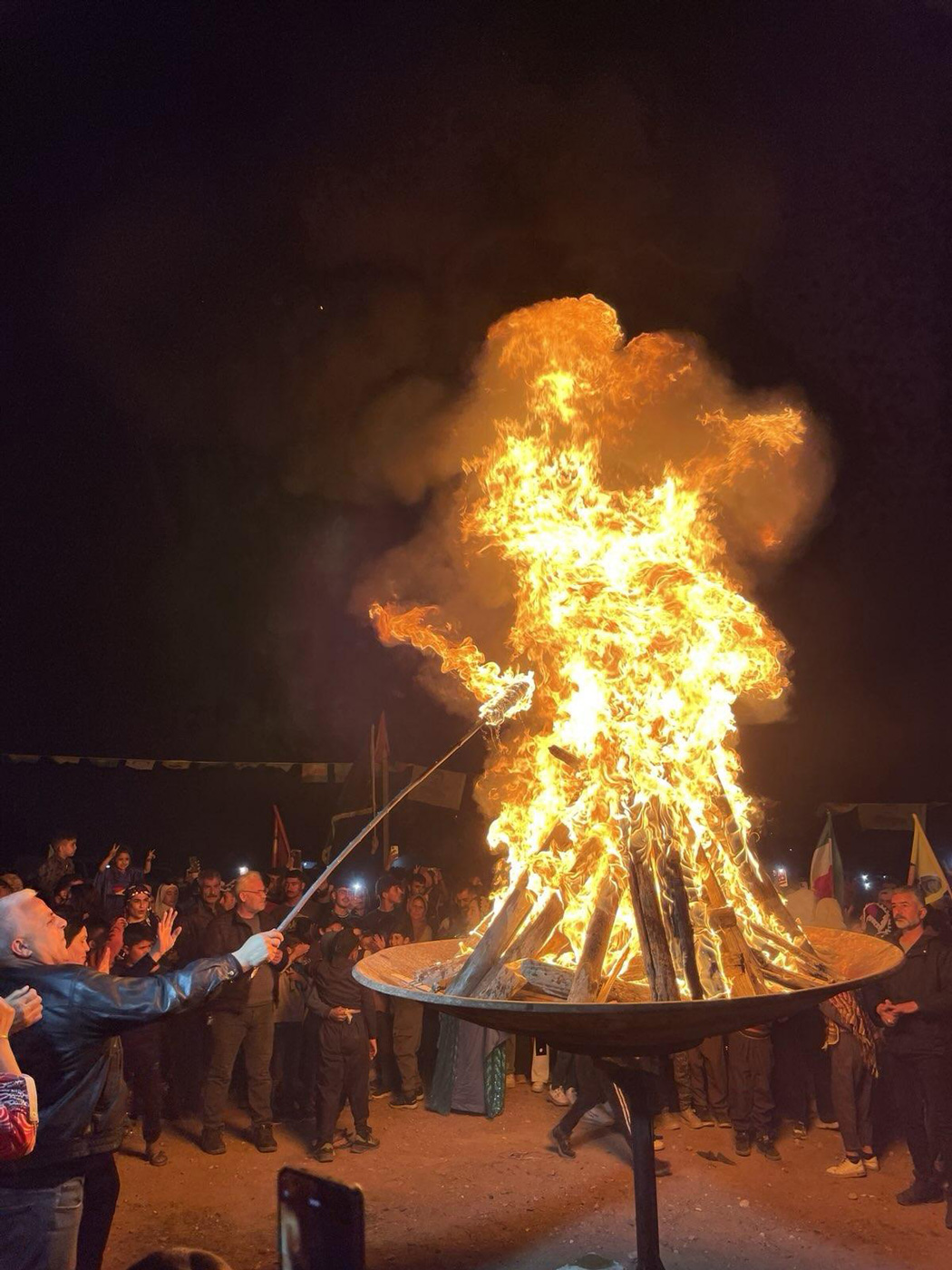
People in Rojava celebrated Newroz.
Further Reading
- Interview with Tekoşîna Anarşîst on Anarchist Participation in the Revolutionary Experiment in Northeast Syria
- The Roots of Turkish Fascism
- The Threat to Rojava
- Têkoşîna Anarşîst—The website of a revolutionary anarchist organization working in northeastern Syria


