
![[Aggregator] Downloaded image for imported item #269808](https://batshitcrazy.com/wp-content/uploads/2026/03/header-1068x712.jpg "[Aggregator] Downloaded image for imported item #269808")
On March 1, 2026, at the conclusion of a week of action against the Immigration and Customs Enforcement occupation of the Twin Cities, protesters converged on the Bishop Henry Whipple Federal Building in Fort Snelling, Minnesota. At least four hundred people marched on the southeast side of the building to demand that ICE withdraw from Minnesota and that the land Fort Snelling occupies be given back to the Dakota people. Many Native people participated in the march, including members of the Dakota, Ojibwe, and Chippewa tribes. On the opposite end of the building, a group of fifty protesters blockaded Minnehaha Avenue with shields, reinforced banners, homemade tank traps, and improvised barricades.
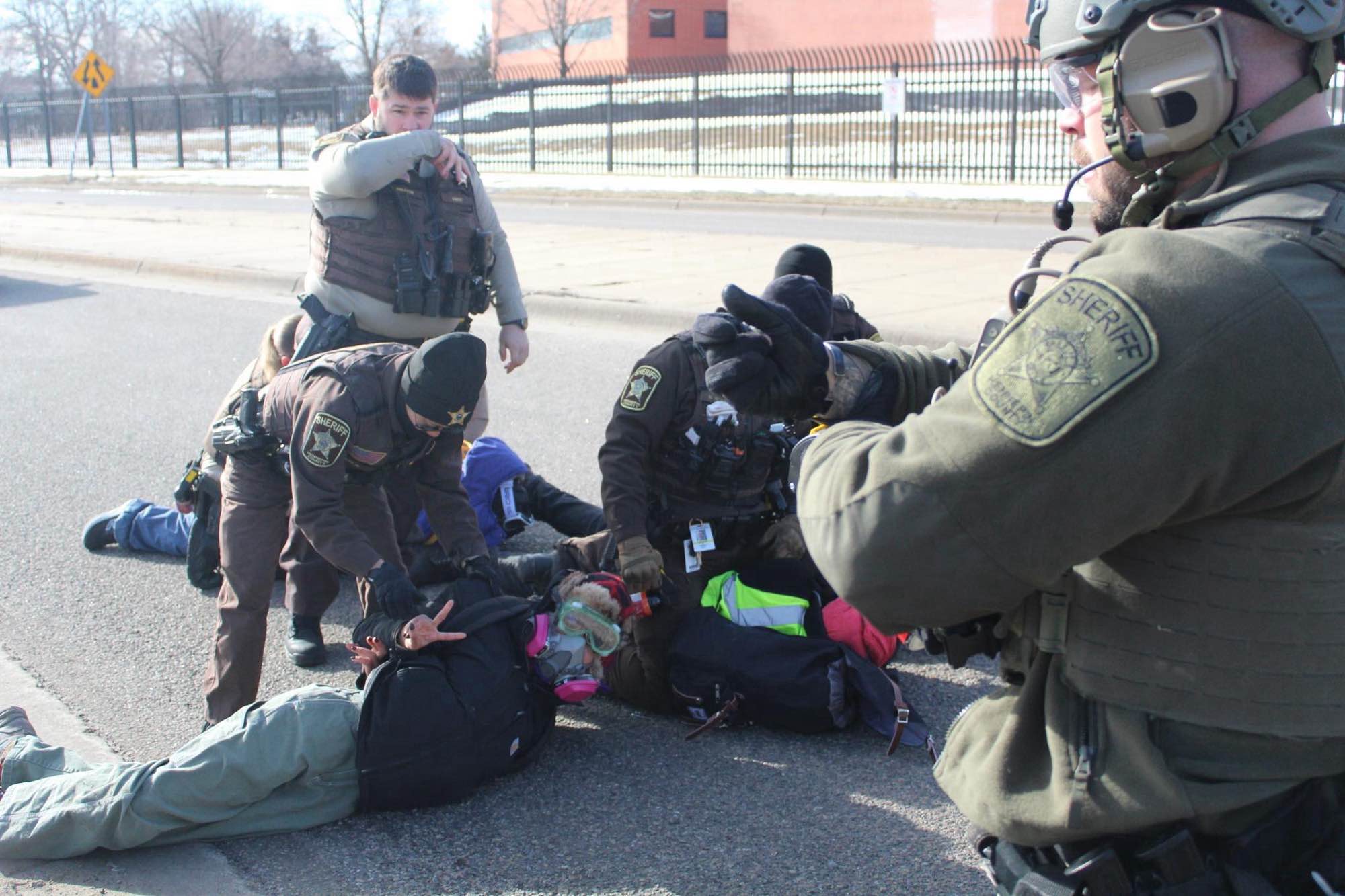
Hennepin County Sheriffs and Minnesota State Troopers attacked both protests almost immediately. They tackled and dragged dozens of people out of the march on the southeast side. At the blockade on the northwest side, they beat protesters, sprayed them with bear mace, and slammed a person’s head against the pavement. One person bled from their eyes and suffered corneal damage from taking so much mace.
The sheriffs arrested forty people in total. Ten of these arrests occurred at the blockade and thirty at the march. The first attacks on the march did not occur until after the barricades on the other side of the building were cleared away. Presumably, the blockade functioned keep pressure off the march by drawing police attention elsewhere.
From Chicago to the Twin Cities, local and state police who answer to Democratic officials have played an essential role in enabling ICE to terrorize communities. Without the continuous assistance and support of local authorities, federal agencies would have been outmaneuvered by protest movements long ago. Every time cops and sheriffs participate in brutalizing those who oppose the ways that ICE is abducting and murdering people, this shows the complicity of Democratic officials in the rise of fascism.
Despite the hardships that the participants endured, this brave action shows that the resistance to the ICE occupation of the Twin Cities is not over. In replacing so-called “Commander at Large” Greg Bovino with “Border Czar” Tom Homan, Donald Trump is trying to rebrand the agency responsible for the high-profile murders of Renee Good and Alex Pretti. (Homan himself accepted a bag of $50,000 in return for promising to distribute government contracts in an FBI sting operation in 2024, aptly illustrating how the persecution of immigrants functions as a cover for government corruption and the military-industrial complex.) Yet even after the withdrawal of thousands of ICE agents from the Twin Cities, more than 400 remain—an unprecedented number before the surge of federal mercenaries into the city two months ago. Thankfully, people are not finished fighting ICE.
Here, an anarchist in Minneapolis who participated in the blockade action describes what happened.
Account
It was a cold, bright morning when I got to the north lot outside Whipple. About forty people were already there. I was nervous. Our numbers were dangerously small. We knew going in this would be a smaller action, but I felt exposed. The wind buffeted us in the shadow of the seven-story concrete detention center. Were we about to get slaughtered?
We waited a few minutes. People hugged each other and huddled in their affinity groups whispering pep talks. Eleven more comrades trickled in. I counted every one of us, then counted again. Two Hennepin County Sheriff cars were watching from the other side of the parking lot. We had scarcely more than fifty people.
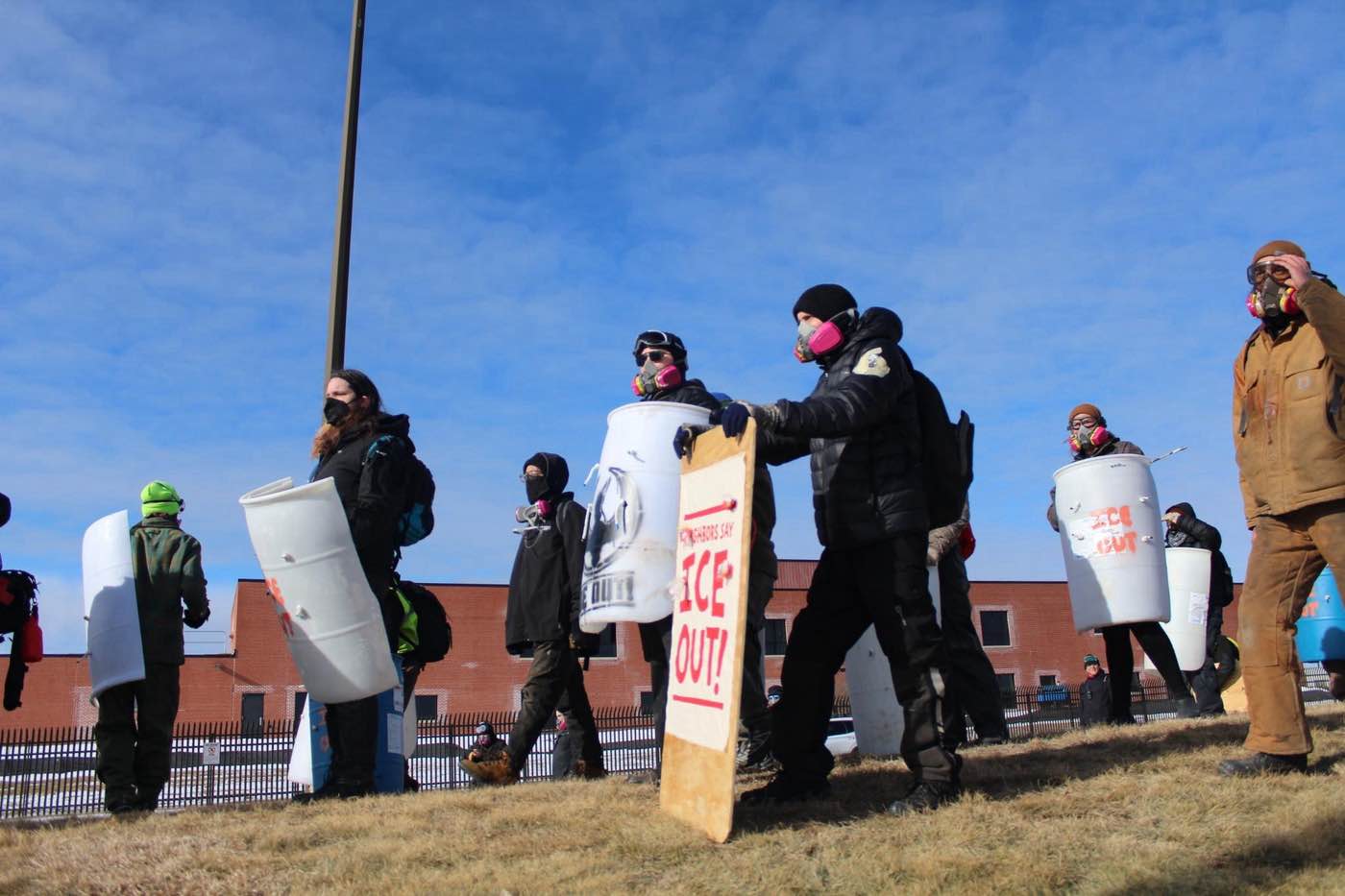
A van swerved into the north lot and screeched to a halt. The first deployment team leaped out, already in gas masks, and started throwing hastily-painted plastic shields out of the back of the van. Everyone scrambled to empty the van, fastening respirators and goggles to their faces and grabbing shields. The sheriffs got out of their cars; they were yelling into their radios calling for backup. A cop car heading south towards Whipple made a sharp U-turn and plowed over the curb of the median strip to cut us off.
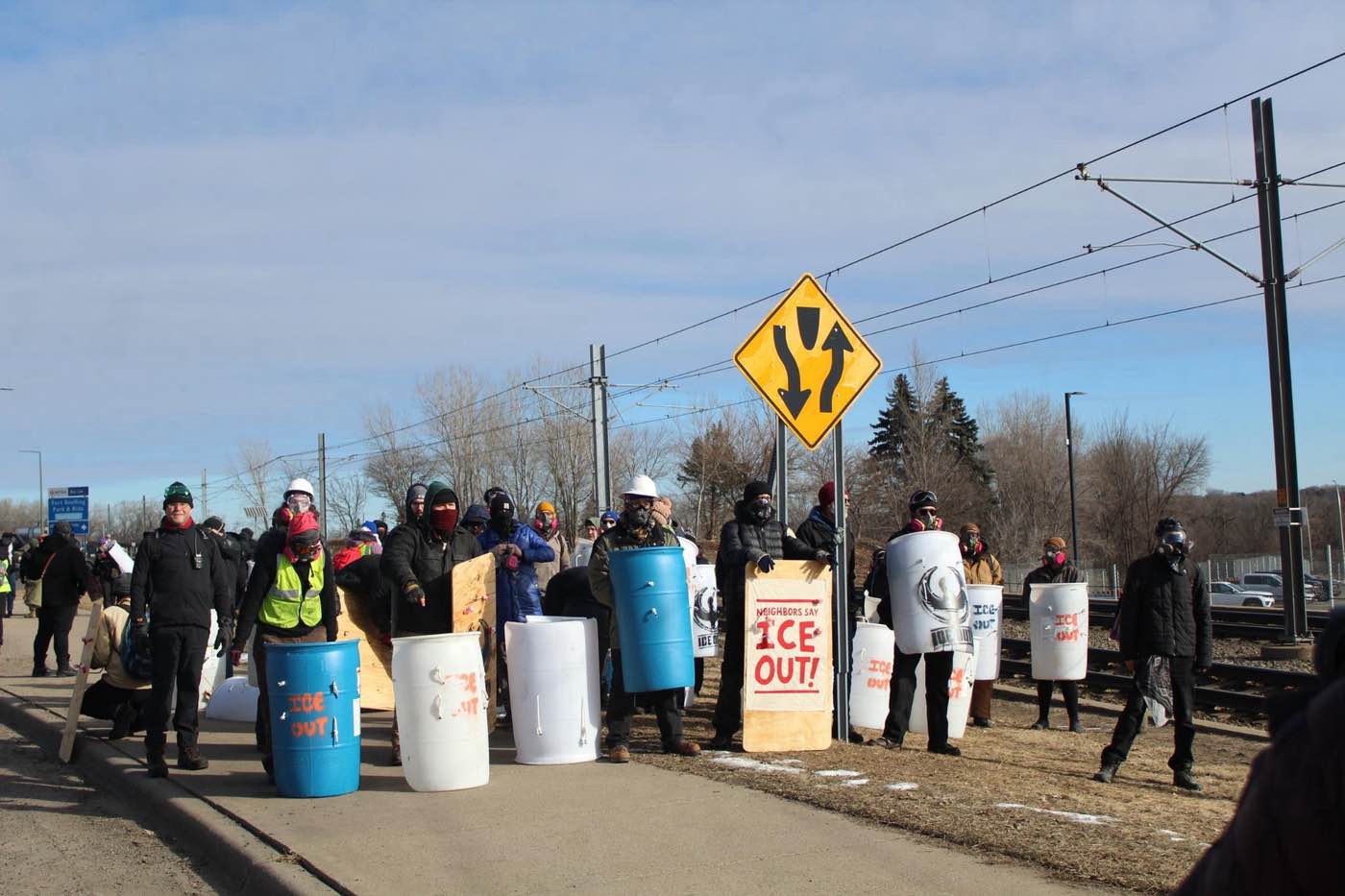
We had barely left the parking lot when a stout, mustachioed sheriff pepper-sprayed the person to my left. The person flinched and fell backwards, but did not cry out. Medics started flushing their eyes. We kept pushing forward.
A line of sheriffs blocked our path before we reached our intended blockade point. Some of them were in normal uniforms; others were in full kit tactical gear, looking almost exactly like the federal agents who guarded this area in the recent past. One of them menaced us with a can of bear spray. I fiddled with my goggles, frantically trying to stop the damn things from fogging up in the cold.
“IF YOU HAVE A SHIELD, PUT IT ON THE GROUND NOW!” a sheriff bellowed at us. He bellowed the same phrase again, and then a third time.
“Not today, asshole,” somebody to my right shouted back. “Is your family proud of you, you fucking pig?”
The cops ran at us. They maced somebody. They started grabbing shields and wrenching them out of people’s hands. I was standing in the front. A sheriff put both his hands on the top of somebody’s shield and they wrestled back and forth over it. The person let go of the shield, and the sheriff toppled backwards and fell on his back.
Somebody started shouting instructions to fall back. Most of us did. The sheriffs tackled two brave people who were slower to retreat. Three or four officers dogpiled onto each of them. One person’s helmet flew off and they struggled to stand up. A sheriff threw himself on top of them, smashing their head onto the sidewalk with an audible crack.
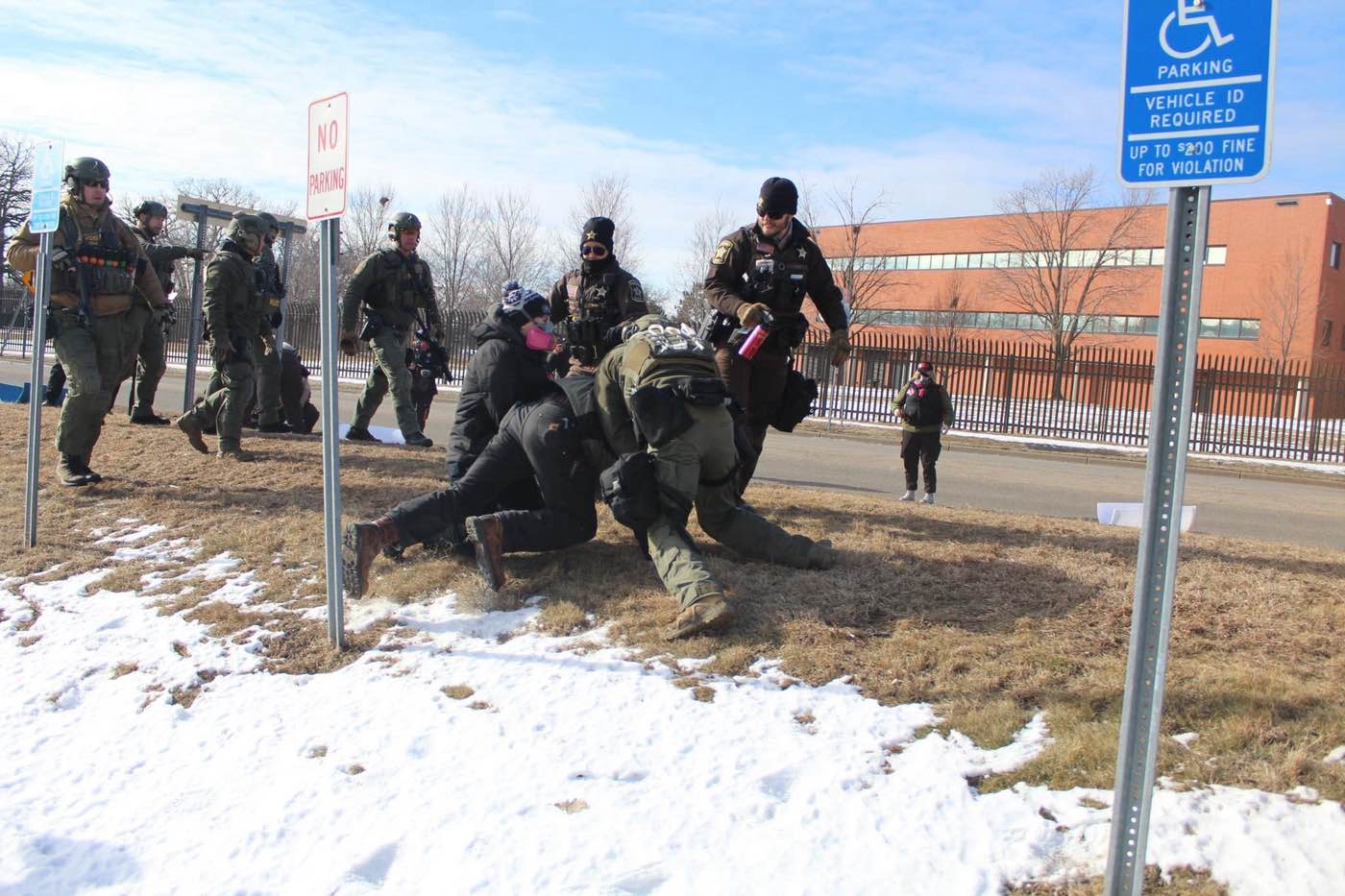
Someone with a bullhorn walked out into the street, attempting to take the road a second time. She started a chant: “Whose streets? Our streets!” The cops immediately tackled her, as well. The rest of us followed, trying to get back into the street to form a shield wall. Two sheriffs flanked the person in front of me and tried to pull them forward. People on our side grabbed the person by the backpack and tried to pull them back. The sheriffs hit us with another jet of bear mace and we lost the person. Someone else in the front was holding the line as best they could, shoving back and forth with their shield. A sheriff tried to grab them by the arms, but a comrade behind them crouched and hugged them around the waist, wrenching them backwards. That person got away.
When the melee concluded, they had arrested ten of us. There were only forty of us left in the street. The number of cops confronting us had dropped, too, as many of them had their hands full detaining our arrested comrades and putting them into a van. We fell back again and put up a shield wall, now with a severely diminished number of shields. Somebody grabbed a pallet and a broken stop sign from the side of the road and threw them into the street in front of us.
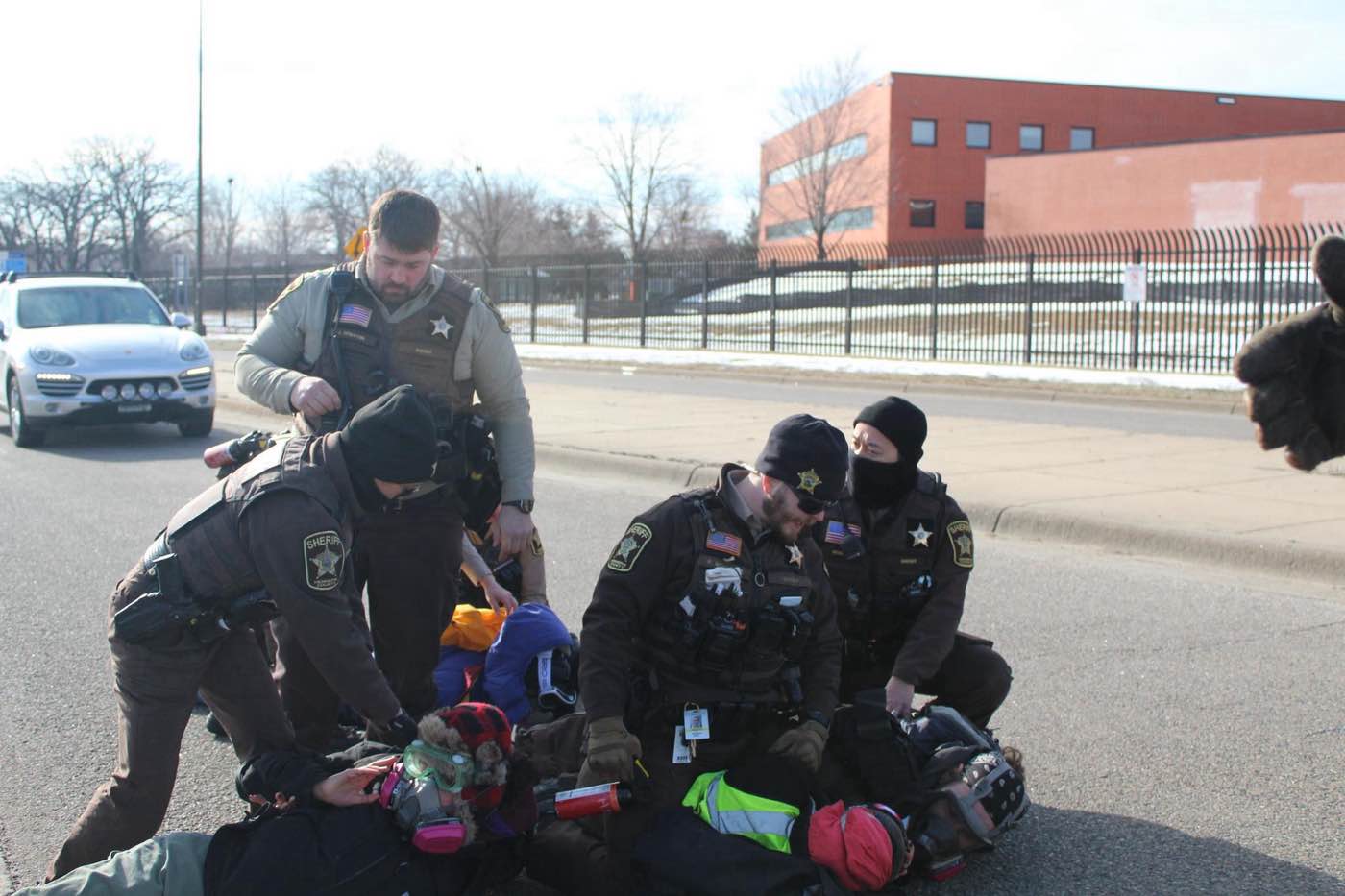
Only after the arrests did the sheriffs issue a dispersal order.
The next ten minutes felt like hours. The sheriffs kept their distance now. I think they were calling for reinforcements. Four vehicles blocked the road in front of us, and two blocked the intersection of Minnehaha and Hiawatha behind us. I was afraid we were going to get kettled. We huddled together in the freezing wind, crouching behind our few remaining shields. A middle-aged woman pulled up her car behind us. For a moment, I thought she could be ICE. Then she yelled out her drivers’ side window: “You guys are all so hot and brave!!!”
Our morale was low by this point, but she helped boost it.
Then, finally, the cavalry arrived. A second deploy team pulled up in a flatbed truck, running late; something always goes wrong at things like this. People swarmed around the back of the truck, ripped away a green tarp, and pulled out buckets of hinges, nails, and scrap metal. We dumped them onto the barricade. We also pulled out three “tankbuster” traps—four-foot-high welded jacks that looked like barricades from the beaches at Normandy, and positioned them to block the road. Piled beneath all this stuff, we pulled out two 8’ x 4’ reinforced banners made of corrugated steel. I wish we’d had this shit 20 minutes ago, I grumbled to myself.
We held the road for another half hour. The sheriffs did not approach us again. Taken aback by the barricade, they were constantly talking into their radios. At 10:24 am, I received a text on my burner phone that the march on the other side of Whipple was no longer holding the street. This meant ICE had an egress point at Gate 3 and were no longer trapped inside. That was our cue to leave. We called our exfil team.
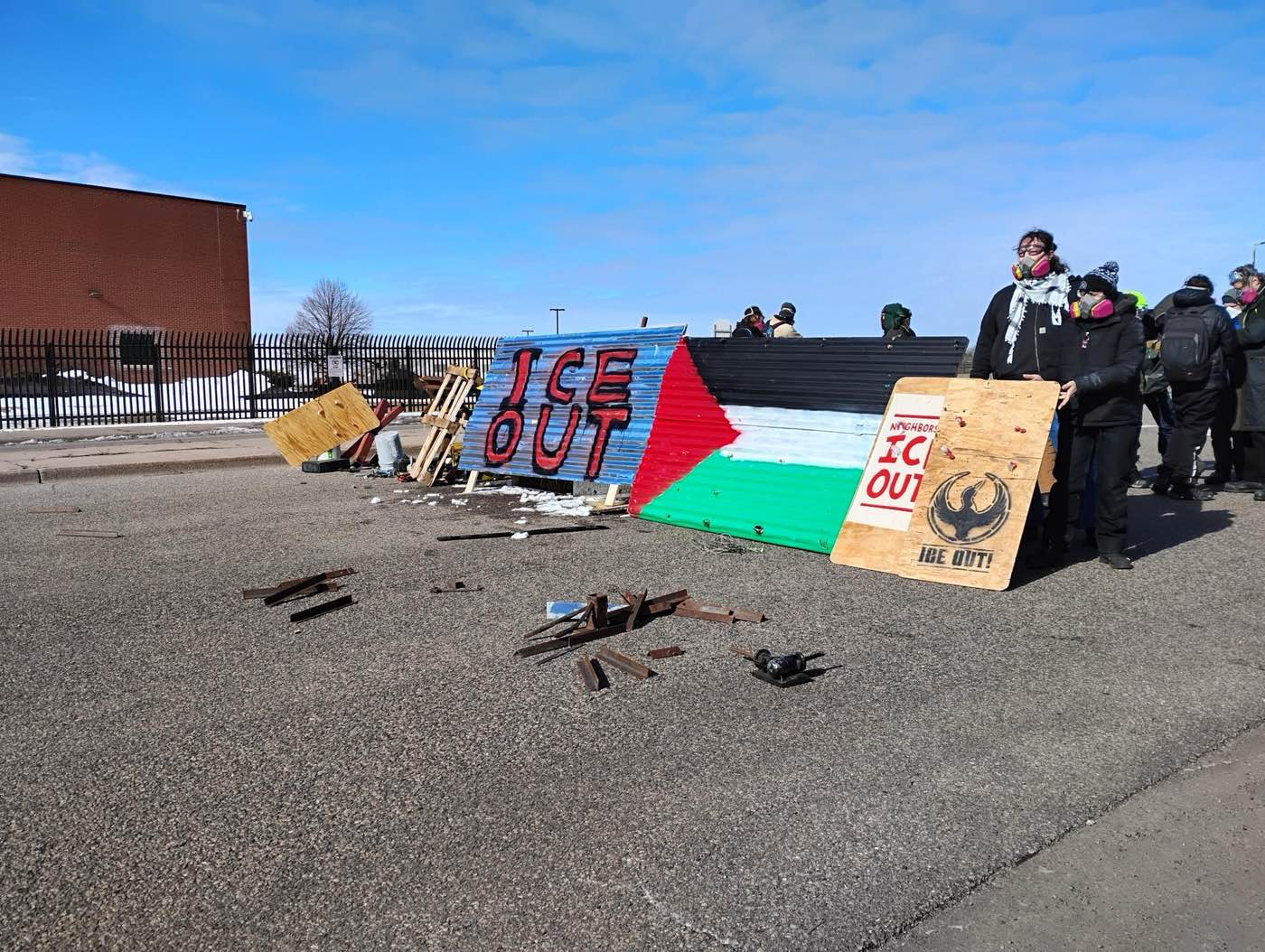
Ironically, the smoothness of our exit seemed to disorient the sheriffs more than anything we’d done at the blockade. Eight cars pulled up behind us and we piled in, abandoning the barricade and peeling off toward Hiawatha.
One car got followed by an ICE SUV on the way out. The driver led them on a chase through South Minneapolis until they reached Powderhorn Park, where they used a local rapid response chat to call for reinforcements. Dozens of neighbors came out to the park, filming with their phones. The ICE vehicle turned around and withdrew.

I was frightened and stressed out during most of the action on March 1, but I did it anyway. Many things went wrong during the planning and execution. We took 20% arrests, and some of the arrestees caught misdemeanor charges. We never had the numbers to properly accomplish our task—yet somehow, we managed to block the road for 52 minutes. Of every organized protest at the Whipple building in the last three months, this one was by far the smallest. It was also the first and only occasion on which we succeeded in fully blocking ICE into their headquarters for any length of time.
What happened on March 1 represents a new phase of the struggle against ICE in the Twin Cities. We are decidedly on the other side of the crest of movement activity that peaked in January. The so-called “drawdown”—which still leaves 407 ICE agents on our streets—was intended to demobilize our movement, and in this respect it has partly succeeded. The thousands who fought them in the streets in January are exhausted.
Yet fight them we must.

“We are not many, perhaps more than you dream of, though we are all determined to fight to the last.”
—Plain Words, 1919
Further Reading
- They Escalate, We Escalate: A Short History of the Fight against ICE in the Twin Cities
- Filter Blockades: A Tactic from the Twin Cities to Fight ICE and Defend Your Neighborhood
- The Noise Demonstrations Keeping ICE Agents Awake at Their Hotels—A Model from the Twin Cities
- Minneapolis Responds to the Murder of Alex Pretti: An Eyewitness Account
- Protesters Blockade ICE Headquarters in Fort Snelling, Minnesota: A Report from an Action during the General Strike in the Twin Cities
- From Rapid Response to Revolutionary Social Change: The Potential of the Rapid Response Networks
- Rapid Response Networks in the Twin Cities: A Guide to an Updated Model
- North Minneapolis Chases Out ICE: A Firsthand Account of the Response to Another ICE Shooting
- Minneapolis Responds to ICE Committing Murder: An Account from the Streets
- Protesters Clash with ICE Agents Again in the Twin Cities: A Firsthand Report
- Minneapolis to Feds: “Get the Fuck Out”—How People in the Twin Cities Responded to a Federal Raid


