
By The Ghost of HST
May 5, 2025
Let’s not lie to ourselves — we missed the exit. The 2°C threshold? Gone. We blew past that off-ramp in an SUV with “Don’t Tread on Me” stickers and a yacht in tow. The Arctic is bleeding out. The Saudis won’t stop drilling until the desert is dry. (See our Bloligarch of the Month feature on Yasir Al-Rumayyan, oil daddy to the stars.) Putin — well, Putin’s been rich. He runs a gas station with an army and he’s not planning on closing up shop.
We had our shot. Instead, we bought bigger trucks, built bigger cruise ships, and let politicians turn science into a sideshow. We hollowed out rail systems, slashed climate funding, and pretended carbon offsets were anything but indulgences for the guilty rich. (We’re looking at you, Leo.) We’re not even pretending to stop the warming now. We’re trying to manage it — like a bad haircut or a supply chain delay. Climate policy has become the art of losing slowly.
And the planet isn’t waiting.
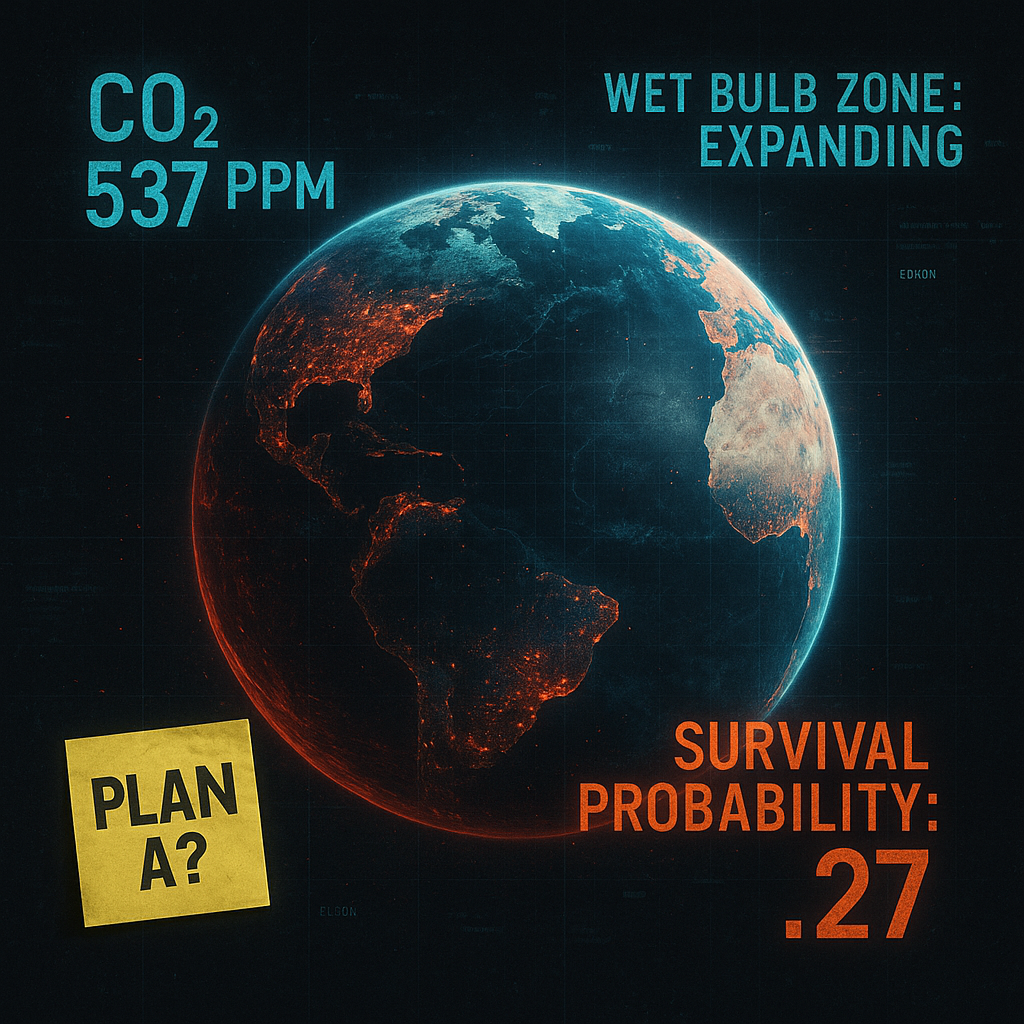
Coastal cities like Miami Beach are already experiencing “sunny day flooding,” with saltwater bubbling up through storm drains on cloudless afternoons. By century’s end, we may find ourselves choosing which parts of New York to defend — and which ones we’ll let the tide reclaim in silence. Phoenix’s airport runways are already softening in the summer heat, grounding planes as asphalt buckles and air density collapses. Parts of the Middle East and the U.S. Southwest could become physically uninhabitable by 2100 due to extreme wet-bulb temperatures — the kind that overwhelm even healthy people sitting in the shade with unlimited water.
We had decades. Now we have years.
The oceans are choking on microplastics, the food web is unraveling from the bottom up, and the Thwaites Glacier — the so-called Doomsday Glacier — is starting to slip. There’s talk now of using geoengineering and AI-guided modeling to temporarily hold it in place, long enough for humanity to get its shit together. That dispatch is coming soon. But the point is this: we waited so long to act that now our best option might be an underwater scaffold held together by cables and prayer, designed by a supercomputer trained on climate collapse.
And now, in our infinite wisdom? We scoff at the idea of AI saving the planet — but what else do we have? Congress? Prayer? A reusable coffee cup?
We’re feeding the machines the climate data, the economic data, the guilt, the chaos. And we’re asking them — praying, really — to do what we never could.
And the machines are answering.
What, exactly, couldn’t we do?
We couldn’t summon the collective will to decarbonize our economy. We couldn’t sacrifice quarterly profits for planetary survival. We couldn’t agree on a global carbon tax, or build a grid that doesn’t collapse when the wind dies or the heat spikes. We couldn’t fund mass carbon removal at scale, and we still haven’t figured out how to sequester the billions of tons of CO₂ we’ve already released — the kind of industrial-scale extraction that might have given us a fighting chance. Instead, we branded carbon as “offsets” and sold guilt like airline miles.
So now, with no real plan and no political appetite for restraint, we’re eyeing the atmosphere itself — not to prevent collapse, but to stage-manage it.
This is the age of geoengineering — not as science fiction, but as last resort.
Geoengineering, in its broadest sense, refers to the deliberate, large-scale manipulation of Earth’s systems to counteract climate change. The proposals range from the baroque to the barely believable: stratospheric aerosol injection to reflect sunlight away from the planet, iron seeding in the ocean to trigger carbon-hungry plankton blooms, massive machines that inhale carbon and exhale synthetic fuel, and yes — the potential to artificially reshape rainfall, wind patterns, even regional temperatures, all governed by models too complex for the human brain to parse without help.
That help now comes in the form of artificial intelligence.
AI is not a miracle. But it may be the only tool we’ve built that’s fast, tireless, and indifferent enough to simulate the chaos of planetary engineering at scale — to run the impossible math, to see through the fog of unintended consequences, and maybe, just maybe, to help us survive our own design.
Kids, we’re in the land of the Fermi Paradox: the eerie question of why we haven’t seen intelligent life elsewhere in the universe. Is it because advanced civilizations always reach this point — a technological precipice — and then vanish? Or is this the moment we break the cycle? (See also: The Great Filter.) Some existential risk models give us just a 27% shot at making it through the next century intact. Better odds than Russian roulette — but only barely.
And what does this look like in practice?
In Silicon Valley, startups like ClimateAi are using machine learning to forecast supply-chain disruptions and agricultural collapse. Their latest tool, ClimateLens, monitors crop yields across volatile regions in real time. Meanwhile, Cervest is helping corporations and governments assess long-term risks to physical infrastructure with asset-level AI modeling.
In Washington, NOAA has launched its own Center for Artificial Intelligence, aiming to supercharge weather prediction, storm forecasting, and sea-level monitoring. Partnering with private firms, they’re trying to retrofit bureaucratic data into something that learns faster than Congress can filibuster.
In China, cloud-seeding is becoming a state-backed climate strategy. A recent test increased rainfall by over 4% across 8,000 square kilometers — equivalent to thirty Olympic pools’ worth of precipitation in a single day. These aren’t trial balloons. This is weather modification at geopolitical scale.
In the EU, Horizon Europe is funneling billions into AI-enhanced resilience planning — trying to predict how drought will move through Spain, how heat will reorganize French agriculture, how floods will reconfigure Dutch cities.
And in the global South, where no one expects a bailout, scientists are building open-source AI models to predict cyclone paths, manage irrigation, and track carbon sinks — all with a fraction of the funding and none of the arrogance.
Each dispatch in this series will bring you a real, working example — or a promising new project — of how AI is being used to confront the planetary crisis we created. No hype, no hand-waving, just the machine and the mess it’s inheriting.
And while tomorrow’s Daily Dispatch may be about Trump eating his buggers live on Fox News, we will keep bringing you these stories — like a life-giving IV drip — interspersed between all of the bullshit.
📚 Further reading: The Geoengineering Gamble by Gernot Wagner — not a pitch, just a survival manual.
Filed from a drifting sub beneath the Thwaites Glacier, listening for cracks in the ice and billionaires in pressure-tested coffins.


