Filed by The Ghost of HST — May 23, 2025
They call it the Doomsday Glacier, and while the name sounds like something out of a late-night disaster special, the threat it represents is both real and immediate. Thwaites is a monstrous mass of ice, larger than the state of Florida—over 192,000 square kilometers compared to Florida’s 170,000—lodged in the western Antarctic like a stopper in a shaken bottle (source). If it goes—and scientists increasingly agree that it’s a matter of when, not if—then so does the fragile illusion of coastal permanence. Miami, Mumbai, Bangkok, and the financial districts of Lower Manhattan are all written into its will. What would that cost—in lives, in cities, in global chaos? Wall Street with gondolas. Bangkok stewing in a sludgy, mosquito-choked swamp. And Miami, the next Atlantis—but with better nightlife, sky-high insurance premiums, and Go Fast boats as the preferred method of transportation.
No one’s talking about reversing the damage. That era is gone. What’s on the table now is far less heroic and far more desperate: buying time. There are serious proposals underway to geoengineer the glacier—by constructing underwater sills to block warm ocean currents, building artificial ridges beneath the ice to slow its collapse, or even deploying fleets of snow machines to artificially cool the surrounding air (source). Maybe toss in some chairlifts while we’re at it, so Vail Resorts can add the West Antarctic Ice Sheet to the Epic Pass—since there won’t be much snow left anywhere else. It sounds absurd because it is, and yet it’s also the most rational plan we’ve got left.
Dr. John Moore, a glaciologist at Beijing Normal University, notes, “If we can stabilize the ice shelves, we might delay the collapse of the West Antarctic Ice Sheet by several decades, buying valuable time for adaptation and mitigation efforts.” Professor Julian Dowdeswell, Director of the Scott Polar Research Institute, adds, “While geoengineering is not a silver bullet, targeted interventions could play a role in managing sea-level rise risks.”
That’s the quiet hope: thirty to fifty more years. Not a fix. A window—maybe, if we’re lucky, to climb out the fire escape before the whole building collapses in on itself.
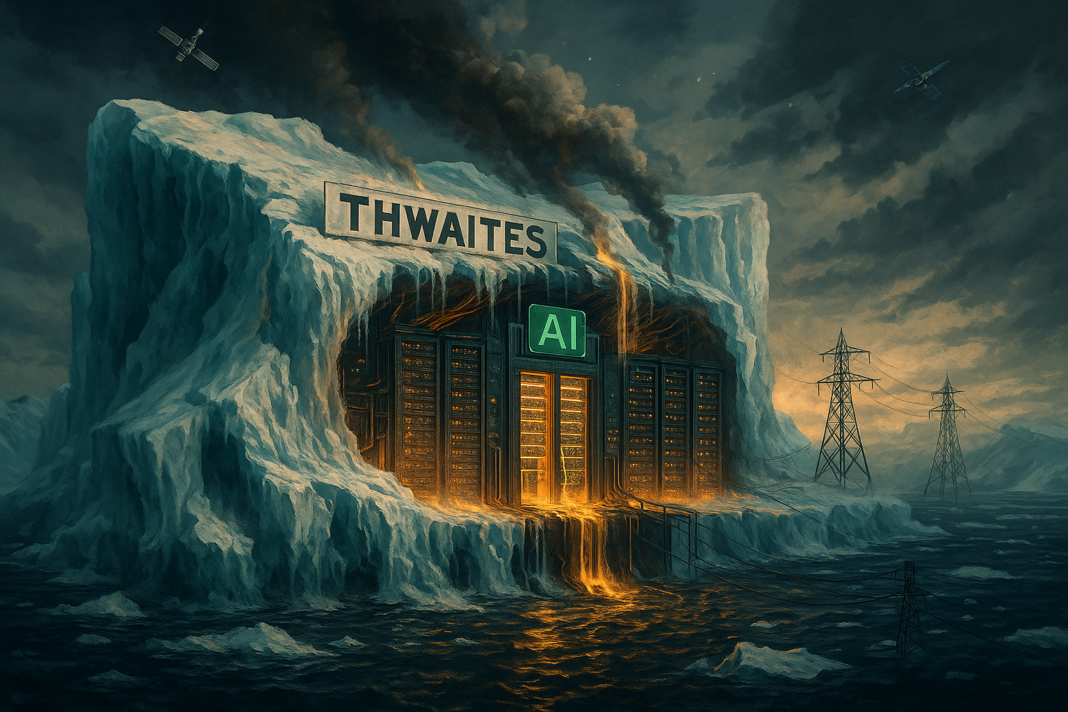
And inside that window—racing against both physics and entropy—is the second part of our bet: the massive global acceleration of artificial intelligence. The early-stage cost estimates for interventions at Thwaites range from tens to hundreds of billions of dollars, depending on the scale and longevity of the proposed engineering efforts. Considering the world GDP is estimated at $106.2 trillion, it’s not an unreasonable sum.
That pales in comparison to what we’re spending elsewhere. Even as glaciers melt, Sam Altman and OpenAI—as we wrote about yesterday—have announced the intention to put $500 billion into AI infrastructure. One planned facility by OpenAI and Nvidia in the UAE, announced yesterday, will span ten square miles. According to reports, “Oracle (ORCL), Nvidia (NVDA), Cisco Systems (CSCO), OpenAI, and G42 are collaborating to build the 10-square-mile Stargate UAE AI campus in Abu Dhabi with a 5-gigawatt capacity. The project, part of a $100 billion U.S.-led AI initiative with an additional $500 billion committed over four years, will feature a 1-gigawatt compute cluster and a 200-megawatt AI cluster launching next year.”
These facilities, according to proponents like Oxford’s Anders Sandberg and sustainability optimists inside the AI research world, will train models that might, in theory, help us avert planetary disaster: neural networks that could model complex climate dynamics, simulate geoengineering interventions at scale, and optimize our dwindling options—from ocean barriers to carbon capture to global resource allocation. As The Future of Being Human put it, this is a double-or-nothing bet on AI fixing the mess that industrial modernity made—a “solution that might just work, if it doesn’t burn the house down first.” (Source)
Recent studies highlight the substantial and increasing energy demands of AI. As of 2025, AI operations account for approximately 20% of global data center electricity usage. This figure is expected to rise to nearly 50% by the end of the year, with AI potentially consuming 82 terawatt-hours (TWh) in 2025—comparable to Switzerland’s annual electricity usage. By 2030, global data center electricity demand is projected to more than double, reaching around 945 TWh—slightly exceeding Japan’s current total electricity consumption. These figures underscore the significant energy requirements of AI, raising concerns about sustainability, especially if the energy sources remain predominantly fossil-based. While we’re told that renewables will catch up, the reality is that most of these facilities will come online years before the clean energy transition reaches full speed. To build the brains that might save us, we’re lighting fires under our own feet. These data centers aren’t quietly humming—they’re roaring like jet engines, swallowing whole coal plants and belching out carbon like frat houses during a kegger.
But as Thwaites continues to splinter, and the servers hum louder than ever, the bitter truth is that the big decisions aren’t up to us. They’re locked inside boardrooms, bound up in term sheets, and whispered behind the closed doors of Davos cocktail parties. A handful of self-appointed gods deciding if we’ll drown or fly—betting our future on machines we barely understand, let alone control.
Does it all end, as Sam Altman once said (we assume he was partly joking),
“AI will probably most likely lead to the end of the world, but in the meantime, there’ll be great companies.”
(source)
Filed from: A barstool on the Titanic, ordering another round and wondering who’s steering.