
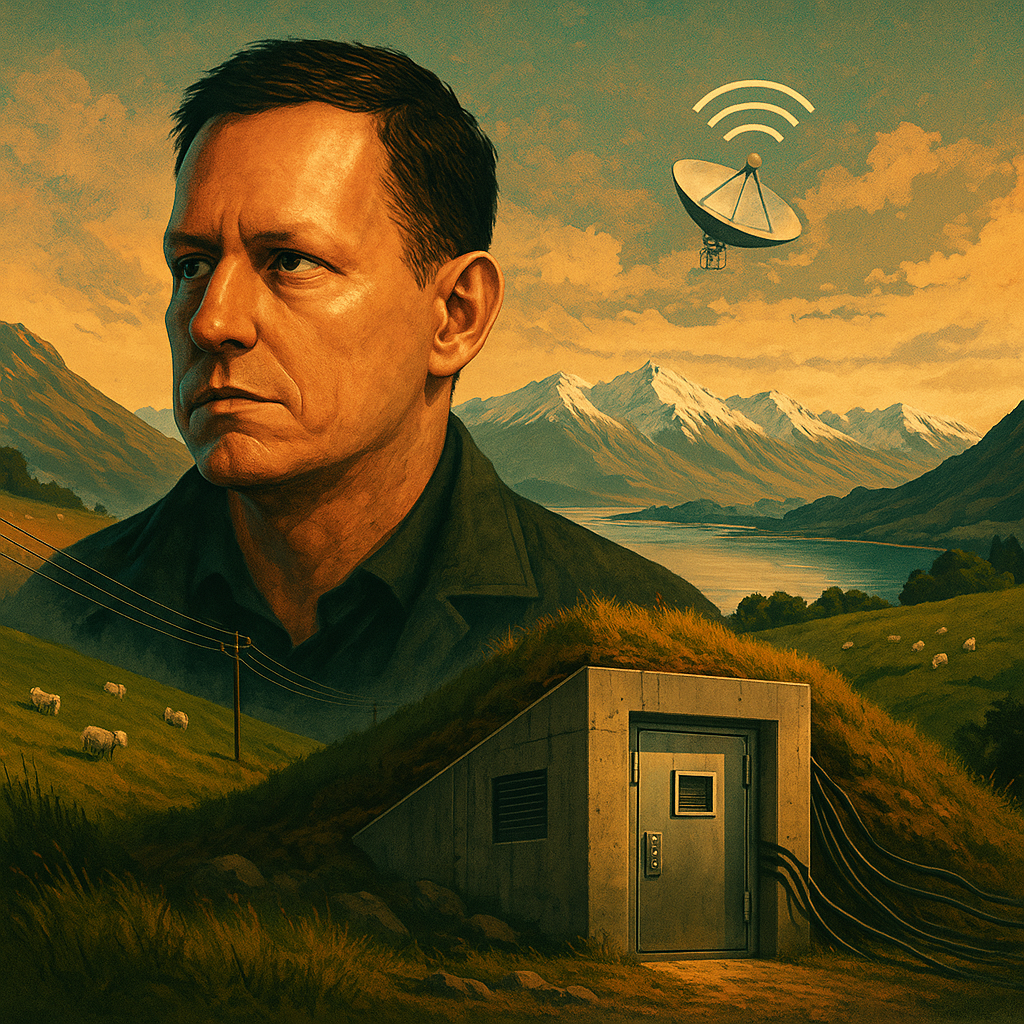
The Toligarch in the Bunker
By Jenny Braddock
06/25/2025
Peter Thiel doesn’t just believe the world is ending — he’s already relocated. Born in Germany, raised in South Africa, naturalized in the U.S., and now a citizen of New Zealand, Thiel isn’t just a billionaire. He’s a billionaire without borders. A Toligarch, as Scott Galloway puts it: a transnational oligarch who floats above national consequence, civic duty, or anything resembling grounded accountability.
And he’s not floating quietly.
Thiel helped birth PayPal, bankroll Facebook, and build Palantir — a surveillance software company now embedded across U.S. defense, immigration, and intelligence agencies. He backed Trump in 2016, funded Hulk Hogan’s revenge crusade against Gawker, and bought himself a remote island hideaway in the event civilization gets too… democratic.
He calls himself a libertarian. But what kind of libertarian builds software for ICE and then buys land near sheep to wait out the collapse?
He is the most ideological man in Silicon Valley who never explains his ideology. Justifies public surveillance with private secrecy. Claims to hate politics while funding its most corrosive avatars. He’s not trying to rule the world — just redesign it in a way that makes him harder to reach.
In short: the perfect broligarch.
The Making of a Toligarch
Before Peter Thiel built surveillance software for ICE or started scouting islands for his doomsday bunker complex, he grew up drifting between the collapsing colonies of Southern Africa. His family lived in Namibia and apartheid-era South Africa before relocating to the U.S. in the late ’70s. His father was a mining engineer. The politics of extraction weren’t just background noise — they were dinner table logic.
This was the world Thiel came from: white, militarized, and steeped in the conviction that some people are meant to rule and others are meant to be ruled. He wasn’t the only one in his cohort to soak up that worldview — Elon Musk and Roelof Botha grew up in the same ideological soup. Different personalities, same gravitational pull: a suspicion of democracy, a worship of “order,” and a deep belief that elites shouldn’t have to explain themselves to the masses.
He landed at Stanford, where he studied philosophy and reportedly kept a list of professors whose politics offended him — proto–cancel culture, but for libertarian hall monitors. Somewhere there’s probably a notebook labeled “Peter’s Enemies,” wedged between a dogeared copy of Beyond Good and Evil and a printout of Ayn Rand’s blood type.
After a brief stint clerking and trading derivatives, he co-founded PayPal in 1998 with Max Levchin and, eventually, Elon Musk — who, like Thiel, was also born in South Africa and shared a talent for injecting disruption into the bloodstream of polite society. They had different styles — Musk was the chaos goblin, Thiel the quiet executioner — but together, they turned PayPal into a functioning middle finger to the banking system.
PayPal wasn’t just a payments app. It was Thiel’s theory of power made clickable: if you could build a platform people needed, regulators would fall in line. He wanted to bypass traditional finance, frustrate governments, and, in his words, “create a new world currency.” But apparently, Visa had other plans.
It worked — just not the way he intended. eBay bought them out in 2002 and turned PayPal into what it is now: the plumbing of Web 1.0. The crowbar became a faucet. But Thiel walked away rich, aggrieved, and more convinced than ever that real power doesn’t come from consensus — it comes from building something so essential even governments have to beg for access.
This wasn’t Silicon Valley libertarianism in the Reddit sense. It wasn’t even capitalism in the Ayn Rand cosplay sense. It was colder. Lonelier. Transnational. This was the seed of the Toligarch. Not a man trying to get rich — a man trying to get free. Free from taxes, free from laws, free from the inconvenience of anyone else’s opinion.
The libertarian endgame: one Wi-Fi router, zero regulations, and a bunker full of Soylent and Spam.
Palantir and the Surveillance State
Newly rich coming off the sale of PayPal, and with the echoes of 9/11 still reverberating, Thiel set his sights on what else — becoming a defense contractor.
Because nothing says small government like building software that tracks everyone from Kandahar to Queens.
In 2003, he co-founded Palantir with CIA seed money and a mission that sounded noble on the surface: help the U.S. fight terrorism with smarter data tools. But beneath the pitch, Palantir was something far more ambitious — and far more chilling. It wasn’t just about security. It was about control. A sprawling software platform designed to integrate and weaponize information, turning raw data into predictive targeting across borders, protests, welfare systems, and war zones. The business model was simple: spy locally, profile globally, invoice monthly.
While other libertarians were still quoting Hayek and stockpiling Bitcoin, Thiel went full Beltway. Palantir became the favored tech contractor for ICE, the NSA, the Pentagon, and local law enforcement agencies from Los Angeles to the Bronx. The company’s unspoken value proposition?
We see what you can’t. And we’ll sell it back to you.
And if you can’t afford it? Don’t worry — they’ll sell it to your enemy.
He didn’t hack the system — he onboarded it. Palantir didn’t need to steal data; it was handed over by federal agencies desperate for a modern edge. Thiel didn’t dismantle big government like a good little libertarian — he monetized its blind spots, wired its agencies together, and now he calls it innovation.
It wasn’t surveillance in the sci-fi sense — blinking red lights and humming drones. No lasers. No black helicopters. Just one UI to rule them all. Dashboards. Databases. A digital latticework of names, faces, movements, and probabilities, quietly feeding governments the illusion of total foresight. If Facebook monetized your likes, Palantir monetized your vulnerabilities.
And while Thiel hasn’t been in the CEO chair for years, the ideology remains unmistakably his. Palantir isn’t just about “data.” It’s about removing the need for messy things like politics, debate, or consent. Decisions shouldn’t be made by elected bodies — they should be spit out by the algorithm, blessed by the machine, and executed by whoever’s in power that week.
“I no longer believe that freedom and democracy are compatible.”
— Peter Thiel
Killing Gawker
In 2007, Gawker published a story titled “Peter Thiel is totally gay, people.” That was the headline. No context, no scandal — just a post written with the smirking cruelty that defined the site’s early voice: catty, fearless, casually invasive. They didn’t break the news so much as shove it into a spotlight Thiel had deliberately avoided. He didn’t respond. He didn’t sue. He didn’t even flinch — publicly.
At the time, Gawker was flying high. It was the height of the celeb gossip era — Perez Hilton was drawing MS Paint dicks on red carpet photos, TMZ was breaking arrests before the cops could, and over at Gawker, Nick Denton’s gossip empire had built a brand on unfiltered irreverence and smug transparency — theirs, but yours too. They outed celebrities, mocked tech titans, and treated media gatekeeping like a blood sport. They were fearless, funny, often mean as hell — and proud of it.
By the mid-2010s, they were moving real traffic, breaking big stories, and celebrating their own messiness as proof they couldn’t be canceled. Even when they stepped in it — like publishing a piece about a Condé Nast CFO trying to hire a male escort — they wore the blowback like a badge of honor. Denton pulled the story under pressure. His staff revolted. But the message was clear: they still thought they were untouchable.
They didn’t know Peter Thiel was already plotting their extinction.
Thiel doesn’t rage. He doesn’t tweet. He doesn’t call a lawyer — he hires ten and waits.
After the outing, he said nothing. But behind closed doors, he started quietly funding legal research into how to bankrupt Gawker. Not sue them. End them. He didn’t want an apology — he wanted erasure.
Then, in 2012, Gawker published a sex tape of Hulk Hogan sleeping with his best friend’s wife. It was absurd, invasive, and exactly the kind of thing Gawker would call journalism if you squinted. Hogan sued for invasion of privacy. And Thiel saw his opening.
He secretly bankrolled Hogan’s lawsuit — more than $10 million in total. Hogan didn’t even know who was backing him. The public wouldn’t find out until years later. It wasn’t a culture war. It was a proxy war, and Hogan was just the leather-wrapped battering ram.
When the $140 million verdict came down in 2016, it didn’t just bankrupt Gawker — it wiped out Denton personally. The entire operation was liquidated. Writers fired. Archives frozen. Everything gone.
And standing in the wreckage?
Hulk Hogan.
Real name: Terry Bollea. American icon. Blonde handlebar mustache. Eight-time world wrestling champ. And now, officially, the man who killed Gawker — with Peter Thiel’s money in his pocket and a do-rag on his head.
It was almost too strange to believe. Hogan had testified that his sex tape persona and real-life persona were legally distinct. The jury bought it. And somewhere behind the scenes, Thiel was watching the whole thing unfold like the world’s most vindictive dungeon master.
Only after the dust settled did the press learn the truth: Thiel had funded the entire operation from the shadows. Hogan was the blunt instrument. Thiel was the architect.
The takedown sent shockwaves through journalism, Silicon Valley, and everyone who’d ever pissed off someone richer than them. Was it justice? A warning? A one-off blood feud?
It didn’t feel like precedent — until people started treating it like one.
A billionaire had bankrolled a secret war to destroy a media company over a personal grudge. And it had worked. The free press hadn’t just been sued — it had been strategically erased.
Some cheered. Others panicked.
Even people who hated Gawker understood the danger: if a billionaire can burn a newsroom down in secret, who gets lit up next?
Thiel didn’t gloat. He didn’t need to.
He gave a few restrained interviews, called it “a philanthropic act,” and went back to Palantir, New Zealand, and whatever test lab was working on stopping time.
Now, years later, Hollywood’s finishing the story for him, we hear with his tacit approval. Ben Affleck and Matt Damon are producing Killing Gawker (that is a title) through their Artists Equity shingle, reportedly with Affleck in the role of the Hulkster. The movie will be — a dramatization of the lawsuit, the revenge, and the long quiet fuse Thiel lit under the media world. Gus Van Sant is directing. Of course he is.
It’s a fitting tribute to Thiel’s favorite power play:
Don’t just win. Erase the record. The legend will get the movie made… we hope.
Bunker Logic
Somewhere along the way, Thiel developed a fear of societal collapse that would result in his purchase in 2015 of a 477-acre estate on Lake Wanaka, on the South Island of New Zealand. It wasn’t just remote. It was strategically remote — surrounded by sheep, mountains, a glacial lake, and a national mythos built on hobbits, neutrality, and not being America.
The location was first reported by The New Zealand Herald, who uncovered Thiel’s property acquisition through a holding company after he’d already secured citizenship. The catch? He was living in California at the time — but applying for citizenship halfway around the world. He hadn’t even visited when his application was approved. But New Zealand made an exception — not for residency, but for “exceptional ability in the field of technology.” Apparently, you don’t need to know your neighbors if you can afford to bankroll the island.
Thiel joined a wave of Silicon Valley prepper billionaires who saw New Zealand as a backup plan for civilizational failure — but his plan was bigger than canned beans and solar panels. His estate reportedly includes planning for a luxury survival compound with its own helipad, off-grid power, and the kind of security architecture usually reserved for Bond villains and Amazon data centers.
He wasn’t just hedging. He was seceding.
Not from society, but from consequence.
“I think the fate of our world may depend on the effort of a single person who builds or propagates the right idea at the right time.”
— Peter Thiel
Thiel has called New Zealand “a utopia,” but it’s also his panic room. A private exit ramp from the world he helped destabilize — through political funding, surveillance tech, and public indifference masquerading as libertarian principle.
He doesn’t fear collapse in the abstract. He fears the moment when all the old systems break at once: the dollar, the police, the courts, the food chain, the American illusion of control. When that happens, he isn’t calling 911.
Like so many other billionaire bunker owners — including Zuck, Gates, and Bezos — he’ll be calling a pilot.
MAGA, Masters & the Political Laboratory
Peter Thiel didn’t just support Donald Trump in 2016 — he stepped onstage at the RNC in a blazer and T-shirt, declaring, “I am proud to be gay. I am proud to be a Republican. But most of all, I am proud to be an American.” It was peak Silicon Valley contrarianism: fund the chaos agent, own the libs, and wait for the pieces to fall.
But by 2020, he’d lost the taste for Trump’s circus. The tech bros had moved on from MAGA as a meme. Thiel had something else in mind: build his own candidates.
He put nearly $30 million behind two Senate hopefuls in 2022: J.D. Vance in Ohio and Blake Masters in Arizona. Both were younger, camera-ready, and steeped in the same techno-authoritarian libertarianism Thiel had been incubating for years. Vance won. Masters flamed out. But the message was clear: Thiel didn’t want to fund Republicans — he wanted to manufacture them.
Masters, in particular, seemed built in a lab: Stanford, Thiel Capital, longform blog posts about IQ curves and masculinity. He once co-authored a book with Thiel, Zero to One, and ran on a platform of “Christian values” and “tech innovation” while spouting Red Scare nostalgia and Twitter-pilled aphorisms like “We should eliminate the Department of Education.” This was politics as engineered product — a Senate candidate who sounded like a Discord mod cosplaying as a 1950s dad.
J.D. Vance, meanwhile, is a different animal. According to Twitter, he’s at once a reformed couch humper, a born-again culture warrior, and a former Trump critic turned populist sycophant. Vance has adopted the posture of a Yale Law–educated Marine turned MAGA whisperer. His contradictions made him seem more human than Masters — and more dangerous.
He’s got the glazed-over affect of someone who just read The Fourth Turning four times in one sitting and has decided to govern based on insights gleaned from a bad peyote experience.
Thiel didn’t mind the contradictions. He’s spent decades cultivating them.
- He supports radical deregulation — and government contracts.
- He funds Christian nationalists — and transhumanist scientists.
- He says he hates democracy — but keeps trying to buy a better version of it.
Somewhere under all that is a man who doesn’t seem to like people much.
He calls himself a realist. But his worldview edges closer to misanthropy with capital returns — a conviction that most humans are short-sighted, irrational, and poorly equipped to shape their own future.
“If you’re a single-digit millionaire like Hulk Hogan, you have no effective freedom in this country. You are housed in a penal colony of the professional class.”
— Peter Thiel
Exit Strategy
Peter Thiel has always claimed to be playing the long game. But the longer it goes, the more it looks like he’s preparing to walk off the field entirely — with a second passport in his sock and, ideally, a thumb drive full of brain scans.
- He’s scaled back public appearances.
- Pulled back from Palantir’s board.
- Cooled on the campaign trail.
And increasingly, when he does speak, it’s in riddles.
His net worth, according to Forbes, is currently estimated at $4.8 billion. That’s not “buy an island” money — it’s “buy several, install fiber, and draft a constitution” money.
He once told an interviewer, “We wanted flying cars, instead we got 140 characters.” That was 2011. Now he’s got the surveillance grid, the bunkers, the AI, and the Senators. He got everything he wanted — and he still seems disappointed.
Maybe that’s the point. Thiel’s worldview has always contained a strange blend of apocalyptic pessimism and brutal optimism: that civilization might collapse, but if it does, the smart money gets out early and takes the servers with them.
- He doesn’t trust democracy.
- He doesn’t trust the crowd.
- He barely trusts capitalism — at least not the sentimental kind that still believes in fairness or upward mobility.
But what he does trust is power. Not power through visibility or celebrity or even office — but power through positioning. Infrastructure. Surveillance. Escape routes.
It’s tempting to call him a Bond villain. But most Bond villains want to blow up the world.
Thiel just wants to unsubscribe from it.
- He has no interest in being liked.
- He has every interest in being underestimated.
“I think there are a lot of things where the answers are known, but people don’t like the answers, so they try to ban the questions.”
— Peter Thiel
What comes next? Maybe nothing. Maybe the world ends. Maybe he’s already gone.
But if the lights go out and the servers reboot somewhere colder and quieter, odds are good the new login screen will say:
“Powered by Palantir.”
Things Peter Thiel Has Probably Learned
(As imagined by Jenny Braddock, transcribed from a conversation that absolutely never happened inside a decommissioned missile silo with facial recognition door locks)
- If you want to be truly free, start by being unlikable.
- Libertarianism works best when no one wants to visit.
- Most people don’t need to be lied to. Just distracted.
- A billionaire without borders doesn’t need friends. Just clearance levels.
- Gawker taught me two things: lawyers are cheap, and memory is expensive.
- If democracy worked, it would’ve scaled better.
- Surveillance is fine, so long as it’s directed outward.
- You don’t have to believe in the end of the world to plan for it.
But it helps.
Filed from a hillside above Lake Wanaka, where the sheep are quiet, the neighbors are invisible, and the satellite uplink is stronger than your constitution.



